
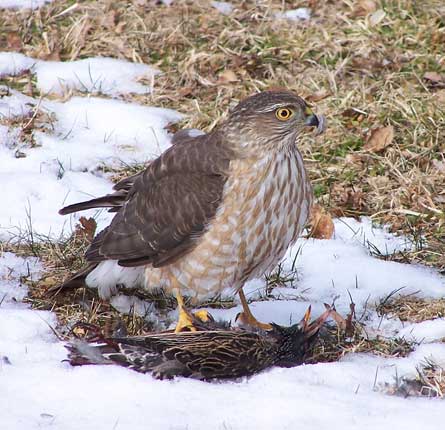
This is (I think) a Sharp-shinned Hawk feeding on a dead starling. Sharp-shinned Hawks are listed as Endangered by the State of Connecticut. It can be difficult to tell a Sharp-shinned Hawk from a Cooper’s Hawk. See ID tips at the The Great Backyard Bird Count website. This hawk appears to be a juvenile (first year.) The photo below of a bird perched on a House Sparrow trap is almost certainly a Sharp-shinned. They are the smallest of our accipiters.
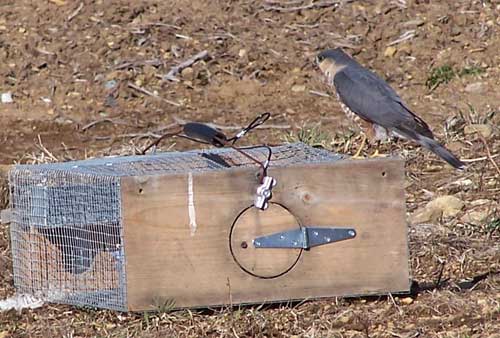
This is almost certainly a Sharp-shinned Hawk. It stayed by this Deluxe Repeating Sparrow Trap (which contained several House Sparrow decoys) for several hours.
The hawk plucked the feathers from the breast first, and they were everywhere. It was mainly picking at the breast and throat area. It was very reluctant to leave the dead bird, and did not fly off until I was about ten feet away. I don’t know if the hawk killed the Starling – it may have found a dead one, as the bird looked like it was frozen.
Cooper’s, Sharp-shinned, and Swainson’s Hawks, and Kestrels will sometimes take birds (especially fledglings) at feeders, and may raid nestboxes.
Related topics:
- Problem or Predator ID and solutions – especially Hawks
- Feeders – Hawk Concerns
- What do do when a Hawk hangs out by a House Sparrow ground trap
- Traps
Previous Pictures of the Week: © Original photographs are copyrighted, and may not be used without the permission of the photographer. Please honor their copyright protection. If you would like to use a photo for educational purposes, you can contact me.
- Tips for photographing cavity nesters
- June 11, 2006 – Great Crested Flycatcher
- June 19, 2006 – Snake Lick
- June 26, 2006 – House Finch Nest
- July 3, 2006 – Tree Swallow in Flight
- July 17, 2006 – Bluebird Battle
- July 24, 2006 – Bear Attack
- August 1, 2006 – Neglected Nestboxes (House Sparrow nests)
- August 14, 2006 – Threesome (Bluebird Babes)
- August 28, 2006 – Peering (flicker)
- January 2007 – New Hill Trail (Sialis)
- February 12 2007 – Sharp-shinned? Hawk feeding on dead starling
- February 19, 2007 – Joe’s Cafe (Suet/Mealworm Feeder)
- March 25, 2007 – Sunflower Eater
- February 2007 – Snags & Suet (Pileated Woodpeckers)
- May 2007 – Birdcam Shots and Birdcam Photo Album
- May 12, 2007 – Carolina Wren nest in a boot
- May 25, 2007 – Batman Bird (Tree Swallows)
- June 2007 – Bluebird nest of cattails, one with leaves, and a TRES nest with maple seeds
- June 20, 2007 – Nine Egger (Tree Swallow nest)
- June 27, 2007 – Black-capped Chickadees (funny and serious photos)
- July 7, 2007 – Anting and Sunbathing
- Red-shouldered Hawk perching on nestbox
- November 18, 2007 – Western Bluebirds at the Spa
- March 15, 2008 – Under Construction – Eastern Bluebirds Building a Nest
- April 9, 2008 – Bluebird Battle in PA
- April 10, 2008 – Mouse Surprise
- April 15, 2008 – Bluebird News (nest in paper box)
- April 23, 2008 – My personal nightmare
- April 25, 2008 – Brave White-breasted Nuthatch
- April, 2008 – How an egg hatches
- May 3, 2008 – Newborn Blue (baby hatching)
- May 3, 2008 – Brave Blue (female on nest)
- May 14, 2008 – House Wren Havoc (eggs pecked)
- May 25, 2008 – House Wren Takeover (of nest, more pecked eggs)
- May 29, 2008 – Take Your Pick (parents feeding fledgling)
- June 10, 2008 – That Look Belongs in a Holster (female MOBL)
- August 23, 2008 – Cat on Nestbox
- September 28, 2008 – HOSP on the House
- October 10, 2008 – Cuddling nestlings (taken in summer time)
- October 27, 2008 – HOSP in flight
- October, 2008 – Possible double and dwarf egg in one nest
- December 16, 2008 – The Next Generation (children building boxes)
- January 22, 2009 – Blue with Cold
- January 28, 2009 – Prothonotary Warbler on a camper | Nest building PROW | PROW nesting in tree cavity
- May, 2009 – To Kill a Mockingbird (Snake eating mockingbird – may be disturbing)
- May 21, 2009 – Should I Stay or Should I Go Now? (Titmouse nestling in box)
- May 25, 2009 – Which of these is not like the others? (Cowbird egg)
- May 23, 2009 – The Honeypot at the end of the rainbow (bumblebee nest)
- June 20, 2009 – House Wren nest decorated with Western Bluebird feathers
- June 20, 2009 – Wonderful WEBLS of WA
- June 20, 2009 – Bluebirds of Bickleton
- July 12, 2009 – Hairy Shrimp (newborn bluebirds)
- July 2009 – Diet (bluebird with earthworm in beak)
- July 2009 – Bluebirds nesting outside of cavity
- July 19, 2009 – HOSP on Holiday
- July 20, 2009 – Pink bluebird eggs
- August 2, 2009 – Pinkies (baby mice)
- August 2, 2009 – En garde (male bluebird in box)
- September 29, 2009 – 1917 instructions for bird house construction
- I forget when – Rainbox
- April 11, 2010 – nuthatch bark
- April 12, 2010 – My first white egg
- April 12, 2009 – TUTI nest by Keith Kridler
- May 2010 – TUTI newborns
- May 2010 – Christmas Chickadee
- May 2010 – Bluebird and Chickadee eggs in the same nest
- June 2012 – Paparazzi
- April 2013 – Under Construction – Titmouse nestbuilding
- July 2013 – Pink Bluebird Eggs
- July 2014 – Cowbird egg in Eastern Bluebird nest
- July 2014 – Newborn HOSP
- July 2015: Patience Pays (Male Eastern Bluebird)
You cannot begin to preserve any species of animal unless you preserve the habitat in which it dwells. Disturb or destroy that habitat and you will exterminate the species as surely as if you had shot it. So conservation means that you have to preserve forest and grassland, river and lake, even the sea itself. This is vital not only for the preservation of animal life generally, but for the future existence of man himself—a point that seems to escape many people.
-Gerald Durrell, The Nature Conservancy
