
This four-holed box for Tree Swallows was designed by Henry E. Kinney of Massachusetts, and shown on page 70 of John K. Terres’ book “Songbirds in Your Garden” (1953 – updated in 1968), but originally appeared in the Bulletin of the Massachusetts Audubon Society, March 1952. Jeremy Berger of Montgomery, IL modified the plans for standard wood (the plans don’t show the ventilation holes he added.) Download Berger plans in PDF format. This YouTube video shows assembly.
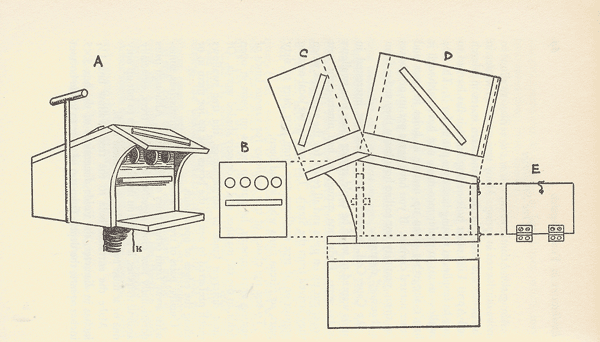
Terres says that the box was designed to “protect young tree swallows from starving and from exposure during spells of rainy and cold spring weather, when they need considerable insect food, which might be difficult for parents to find.” (See info on Tree Swallows found dead in nestboxes.) It has four holes – one that is 1.5″ (for adults) and three 1″ feeding holes which allow adults to feed young faster without entering the box. (Some use a 3/4″ hole for the smaller ones.) This would also help address the tendency to “hole hog” exhibited by older nestlings. Kinney found that more nestlings survived in this design, and more adults returned to nest in them in the spring than in a single-holed box.
The box also has a “T” perch for guarding, and cleats on the roof to facilitate clinging during windy days. (You might want to leave the porch off, as it could enable predation by larger birds). Wood should be 3/4″ thick. The scale of the original detail drawing (which was about 5 inches x 8 inches) is 1/8 inch = 1 inch. Keith Kridler guesses the dimensions are about as follows:
- B or front is 6.75″ Wide by 7.5″ Tall
- main entrance hole is centered 5 1/2″ above the floor (floor nails on underneath the front board to create the landing ledge)
- C or front roof is 6.75″ (including the angle cut) X 8.25″
- D or main roof is 8.25″ X 12.25″
- E or back door is 6.75″ wide by 5″ tall bottom board is 6.75″ wide by 15″ long
- Sides you would need to lay out once you get your other parts cut out.
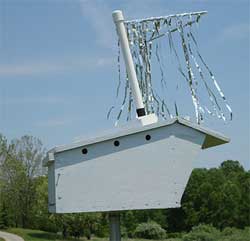
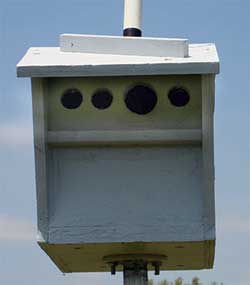 See photos of box made by F. Lovelett. She added ventilation holes on the sides. She said she would also increase the side and rear overhangs, and removed the porch. She finds it difficult to monitor via the rear, and has to use an automotive inspection mirror since the Tree Swallows built their nest way up in front. She has added a sparrow spooker.
MORE INFORMATION & RESOURCES:
- Grid set up for nestboxes
- Tree Swallows, All About
- Tree Swallows, Dead in nestbox
- Tree Swallows, Asynchronous hatching
- Linda Violett’s 2 Hole Mansion
- Tree Swallows, nest, eggs, young photos
- Tree Swallow adult photos
- Nestbox designs – pros & cons
As the pressure of population increasingly regiments us and crowds us closer together, an association with the wild, winged freedom of the birds will fill an ever growing need in our lives.
– Edwin Way Teale, introduction to Songbirds in Your Garden, 1953
