
|
|
Cavity Nester Nests, Eggs and Young Photos and Bios. Also see Nest ID Matrix (contents) and Egg ID Matrix (color, spots, etc.)
Select bird name (alphabetical):
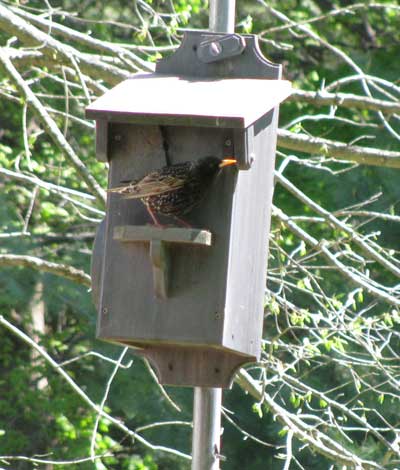 European Starling on a Purple Martin Association Trap box. (When the bird enters the box, it steps on a trigger which drops a bar over the entrance so the bird can not exit. European Starling on a Purple Martin Association Trap box. (When the bird enters the box, it steps on a trigger which drops a bar over the entrance so the bird can not exit.
I allowed this bird to start a nest to get some photos. Starlings are non-native invasive birds, and are serious nest site competitors for native birds. Never allow them to use a nestbox. (They can not fit in a regular 1 & 1/2 inch or 1 9/16″ bluebird sized entrance hole.) See Starling Biology with information on nesting behavior. |
||
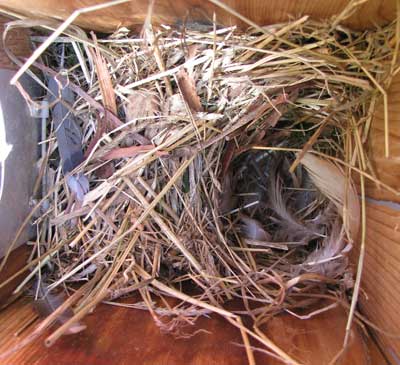 Starling nest in a barnyard (using lots of hay). Photo by Bet Zimmerman. Starling nest in a barnyard (using lots of hay). Photo by Bet Zimmerman.
Nest Description: The nest is bulky and slovenly. The cavity is filled up with grass, weed stems, twigs, corn husks, dried leaves, pine needles, etc, with a depression near the back. Feathers, rootlets, paper, plastics, cloth, string etc. may also be added. The cup lining may include feathers, fine bark, leaves, fine grass etc. Some nests also have fresh green plants (thought to work as fumigants against parasites and pathogens) like yarrow in them. May occupy boxes with holes larger than 1.5 inches. |
||
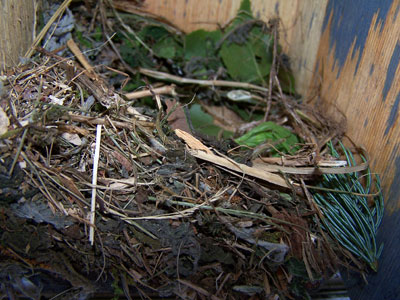 This nest is under construction. This nest is under construction.
For more information, see All About Starlings. |
||
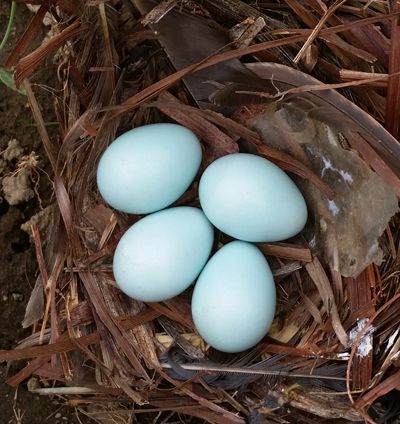 Starling nest with eggs. Notice they are somewhat pointy on the ends. The nest is made with grape vines (and the nest was in a vineyard, which is bad, since starlings eat grapes.) Starling nest with eggs. Notice they are somewhat pointy on the ends. The nest is made with grape vines (and the nest was in a vineyard, which is bad, since starlings eat grapes.) |
||
|
|
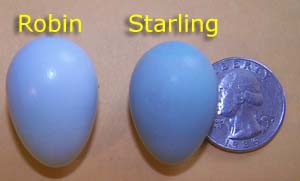 Egg Description: The slightly glossy eggs are pale bluish- or greenish-white (rare reports of eggs with fine reddish-brown spots), and are slightly smaller and darker than a Robin’s egg. Egg Description: The slightly glossy eggs are pale bluish- or greenish-white (rare reports of eggs with fine reddish-brown spots), and are slightly smaller and darker than a Robin’s egg. |
|
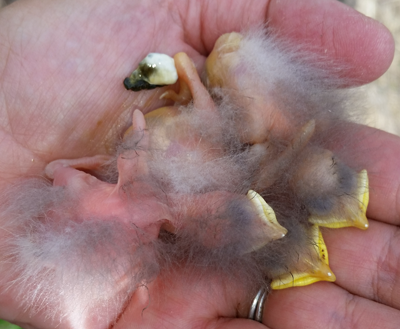 Starling newborns. Notice the clown lips, large size and white fluff towards the rear. Starling newborns. Notice the clown lips, large size and white fluff towards the rear. |
||
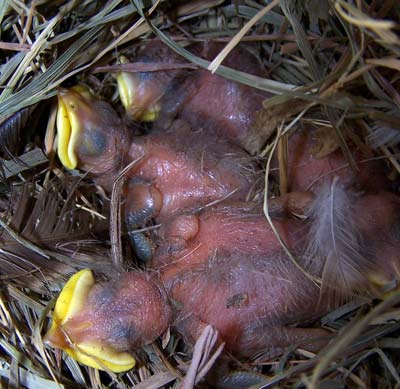 Young: These young are not in a Starling nest. Notice the width of the beak relative to the head. Young: These young are not in a Starling nest. Notice the width of the beak relative to the head.
|
||
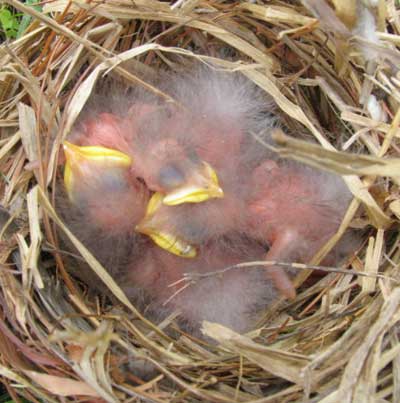 These are probably starling nestlings. Photo by Jay Brindo These are probably starling nestlings. Photo by Jay Brindo |
||
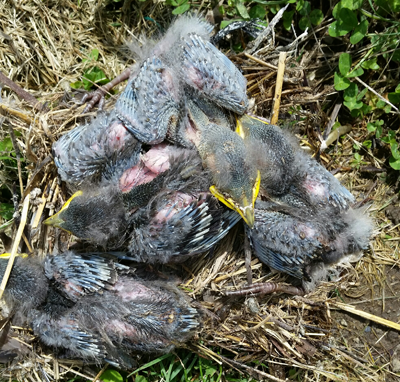 Older starling nestlings with pin feathers. Notice beak has begun to elongate. Older starling nestlings with pin feathers. Notice beak has begun to elongate. |
||
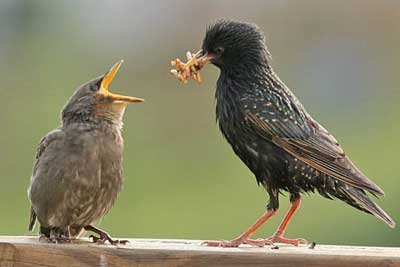 Adult feeding mealworms to fledgling. Photo by Dave Kinneer. Adult feeding mealworms to fledgling. Photo by Dave Kinneer. |
MORE INFORMATION:
- All About Starlings (Biology)
- Problems & Solutions (Predator ID)
- Hole Size Entry Tests
- Hole Restrictors
The student of Nature wonders the more and is astonished the less, the more conversant he becomes with her operations; but of all the perennial miracles she offers to his inspection, perhaps the most worthy of admiration is the development of a plant or of an animal from its embryo.
-Thomas Henry Huxley, British biologist and educator. Reflection #54, Aphorisms and Reflections, selected by Henrietta A. Huxley, Macmillan, 1907.
