

Not all blue eggs are bluebird eggs!
Just because eggs are blue doesn’t mean they were laid by a bluebird. Bluebirds are cavity nesters, and VERY rarely lay their eggs outside of a cavity. (When desperate, they may use a ledge or other location. See photos.)
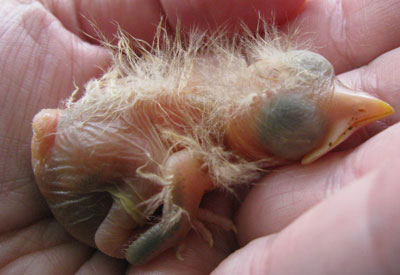
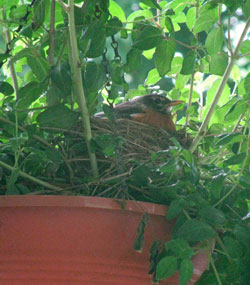
Some people who report finding bluebird eggs in odd locations (in a potted plant for example) are really seeing eggs of another species, like the American Robin nest, eggs, and nestlings in these photos.
House Finches lay eggs that are bluish-green, and sometimes use a nestbox. See more photos.
Starlings also lay blue eggs, but they are bigger than bluebird eggs.
About 4-5% of bluebirds actually lay white eggs.
Robin hatchlings are much larger than bluebird hatchlings, and have longer tufts of white fuzz along their spines and forehead. They are incubated for about 12-14 days, and fledge in 14-16 days. Birds that nest in an “open” cup (vs. cavity nesters) need to develop and get out from their vulnerable location faster. Photos by Bet Zimmerman.
More information:
- House Finch Biology
- Weird Eggs
- Unusual nesting locations for cavity nesters 1 | 2
- White Bluebird Eggs
- Nest and Egg Identification (and photos)
- Starling eggs | Starling Biology
- Bluebirds nesting in a pot and under rafters (photos)
– Malinda Matsuko, Bluebirder, 2005
