
Contents: habitat, hosts, locating a nest, egg removal, egg laying, egg ID, host’s reaction to egg, incubation, nestling ID, fledging, threat posed, bluebirds, solutions, flocking, other names and references. Also see more photos.
Cowbirds don’t build their own nests. Instead, they generally remove an egg from another species’ nest, replace it with one of their own, and then rely on the surrogate parent to incubate the egg and rear the nestling.
There are about 10,000 bird species in the world, but only about 100 are “brood parasites” – i.e., using other birds as foster mothers to care for their offspring (NYT, 2017.) Cowbirds are the only obligate brood parasites in North America. The Brown-headed Cowbird (Molothrus ater or BHCO, 3 subspecies) and Bronzed Cowbird (Molothrus aeneus – found in TX, NW and AZ) breed in the United States. The Shiny Cowbird (M. bonariensis) reached Florida in 1985 and was recently recorded breeding in North America (Sykes and Post, 2001).
Species: Three recognized species – Molothrus bonariensis (Shiny Cowbird or SHCO), M. Aeneus (Bronzed Cowbird or BROC) and M. Ater (Brown-headed Cowbird or BHCO)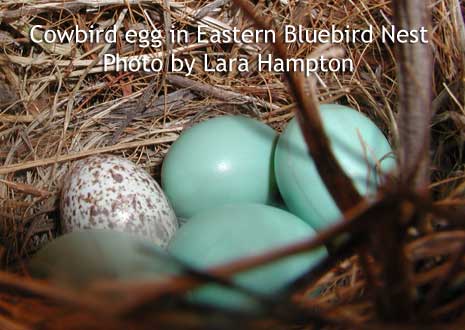
Some naturalists have speculated that because of their nomadic lifestyle (accompanying grazing herds of bison), Cowbirds stray too far from home to reach a nest in time to deposit an egg, so they evolved to rely on another bird’s nest.
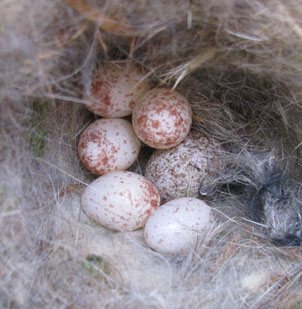
Note: A Cowbird egg looks similar to a House Sparrow egg, but House Sparrows take over the whole nest, and often remove another bird’s eggs from a nest they usurp. Cowbird eggs are larger than House Sparrow eggs, and tend to be more rounded.Habitat: Originally, Cowbirds may have been confined to open country west of the Mississippi. When herds of buffalo were eliminated, Cowbirds started to follow herds of cows. They also extended their range as forests were converted into farms and pastures. Increased winter food supplies (including waste grain in southern rice fields) may have aided expansion. They also benefit from forest fragmentation, as it increases their access to hosts.
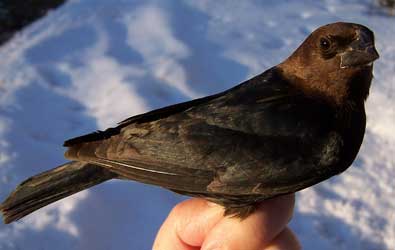
Cowbirds eat about 75% seeds (grasses, weeds, grain) and 25% arthropods (especially during breeding season.) They may eat host eggs removed from parasitized nests, or they may just drop them on the ground.
Brown-headed Cowbirds are now found across most of North America. They are usually in deciduous forests, forest edge and grassland. See BBS map. Bronzed Cowbirds tend to be in partially open habitats with scattered trees or scrub and pastures. They are only found in the arid southwest. See BBS map. The Shiny Cowbird has been documented as breeding in the U.S. (Sykes and Post, 2001.) The rest of the information on this page focuses on Brown-headed Cowbirds, since they are more widespread.
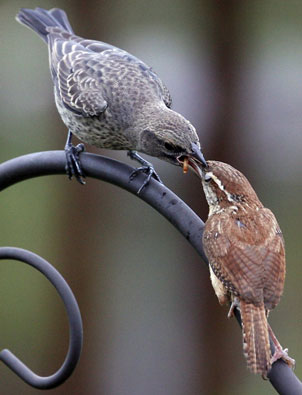
Hosts: Brown-headed Cowbirds have been known to lay eggs in the nests of some 220 (BNA) other species, including a variety of wrens, Great-crested flycatcher, swallows, chickadees, titmice, nuthatches and bluebirds. Genetic analysis indicates that most individuals specialize in a particular host species. About 20% of Eastern Phoebe 25% of Carolina Wren, and 40% of Song Sparrow nests are parasitized. Cowbirds seem to prefer open cup nests, the nests of other birds that also lay speckled eggs, and birds that lay their eggs after sunrise. (See threat posed to certain species.) They have laid eggs in Eastern, Mountain and Western Bluebird nests (2 out of 767 nests in British Columbia study, Campbell et al 1997). Friedmann (1929) felt that woodpeckers, House Wrens, nuthatches, chickadees and bluebirds were seldom molested. Larry Broadbent of MO reported that he only gets a one or two Cowbird eggs each year in about 150-175 EABL nests.
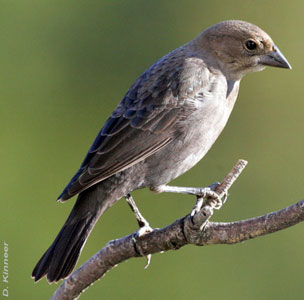
They tend to prefer species with eggs smaller than their own, in active nests with at least two host eggs, small and closed (vs. large and open), and not on the ground.
There is a good list of victims and hosts of parasitic cowbirds here.
Bluebirds: Parasitism in bluebird nestboxes with properly sized holes is not common. Cowbirds occasionally parasitize nests in nestboxes. The female is capable of squeezing through 1.5″ hole, however they probably prefer a larger hole (1.75″ or maybe a Peterson hole). Keith Kridler has found Cowbird eggs right beneath a bluebird nestbox entrance hole, and wonders whether the tight squeeze will sometimes “pop” an egg out of the female as she enters the box.
Locating a nest: Female Cowbirds check out nests in advance. They perch atop shrubs or trees to watch for nest building activities, or try to flush nesting birds by flying and landing noisily.
Egg removal: Once a Cowbird locates the nest, she usually waits until the host has laid two or more eggs, but before incubation begins. She may lay during nest building, egg laying or incubation. She generally (but not always) removes one egg (or two) the day she lays her egg in the nest, or sometimes before.
To remove the egg, the Cowbird pierces it, often leaving a chevron < > beak mark. The eggs may be eaten, or dropped away from the nest. Keith Kridler observed Cowbirds dropping purloined eggs 15 feet and 75 feet from a nest.
 A Cowbird was caught on videotape destroying an entire clutch of 5 eggs from an unattended Western Meadowlark nest. Occasionally they remove eggs without replacing them with one of their own. If there are already Cowbird eggs in a nest (e.g., from another individual) they seem to be able to recognize them. Dr. Lyle Friesen, a songbird specialist with the Canadian Wildlife Service, videotaped Cowbirds parasitizing Wood Thrush nests. Several nests already had a Cowbird egg in them, but he never saw a Cowbird remove a Cowbird egg – they only took the hosts’ egg(s).
Egg laying: begins mid- to late April until mid-July. Cowbirds usually lay about six eggs (one each day) in different nests, wait a few days, and then start again. They may lay more than 11-20 (40 to 41 per BNA) eggs per season. A captive two-year old female was recording laying 77 eggs, 67 of those in a continuous sequence. They may pause for 2 days in between 1-7 eggs.
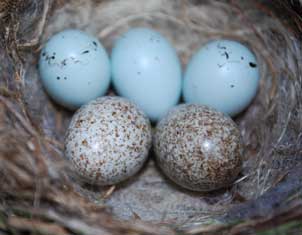
The female usually sneaks into the nest minutes before sunrise to quickly deposit an egg. Egg laying usually takes only 20 – 40 seconds. One Cowbird managed to lay her egg during a four second visit. A Cowbird was videotaped laying an egg while being attacked by both Wood Thrush parents.
About two thirds of the time, only one Cowbird egg is placed in the host’s nest. Sometimes two or more appear, but they may be from different females whose territories overlap. Nine Cowbird eggs were found in one Wood Thrush nest.
Egg ID: Brown-headed Cowbird eggs are usually oval, but the shape can vary to short, rounded and elongate oval. The shell is granulated and moderately glossy. It is white or grayish white (occasionally pale bluish or milky white), with dots and blotches variously described as brown, chocolate, claret brown, tawny, cinnamon rufus, reddish/brown chestnut, or burnt umber. The markings are all over the egg, rarely concentrated into a wreath on the larger end. Although they are about 10% smaller, they are very difficult to distinguish from a House Sparrow egg.
The eggs of the Bronzed Cowbird are pale bluish-green and have no markings.
Host’s reaction to egg: Successful parasitism (for Cowbird hosts) has been recorded for 144 species (BNA). Some birds (e.g., hummingbirds, Red-cockaded woodpeckers) do not successfully rear Cowbird chicks. Some hosts (e.g., Prothonotary Warblers) may desert the nest, or reject it by laying down more nesting material on top of the Cowbird egg (burying it), or removing (ejecting) it from the nest. Female Bluebirds may rebuild the nest cup and lay a new batch of eggs. (BNA). Ed Mashburn of PA reported bluebirds abandoning a nest when a Cowbird egg appeared (apparently replacing the third bluebird egg laid), and rebuilding in another box nearby (and successfully raising a brood.) I had a Black-capped Chickadee desert when the sixth egg was replaced.
Others will incubate the egg and rear the nestling as one of their own. Species vary in their reaction to Cowbird egg deposition. Robins, Gray Catbirds, Blue Jays, Cedar Waxwings, Northern Orioles and Brown Thrashers tend to recognize and reject Cowbird eggs (>88% of time [BNA]). Phoebes tend to accept the eggs. It seems possible that cavity-nesters would be less likely to recognize and reject Cowbird eggs because they see them less often, they nest in dark locations, and some (like Tree Swallows and bluebirds) do not have large bills that would make egg removal easier. Cowbird eggs laid in House Finch nests often “disappear” or the chicks die due to the diet (all vegetable matter) fed by foster parents. There are no reports of Mountain Bluebirds raising Cowbirds.
A recent University of Florida study documented that 56% of the time, Cowbirds ransacked Prothonotary Warbler nests when the Cowbird egg was removed from a parasitized nest, mafia style. They also found that Cowbirds “farmed” a non-parasitized nest by destroying existing eggs so the host would build another that they could then parasitize and get their eggs in ‘synch’ with the hosts’ eggs.
Even though some hosts (Mockingbirds, Wood Thrushes) viciously attack the cowbird female as she sits on their nest, she is typically undeterred, laying an egg in seconds before fleeing the scene.
Incubation: A Cowbird typically hatches at least one day ahead of the young of its adopted siblings, usually in 9-10 or up to 14 days (typically 10-12?) after incubation starts. When Cowbird eggs are larger than the hosts’ eggs, they may affect hatching of host eggs – e.g., 31% of Carolina Wren eggs in a parasitized nest failed to hatch, compared to 9% in non-parasitized nests (Birds of North America online.)
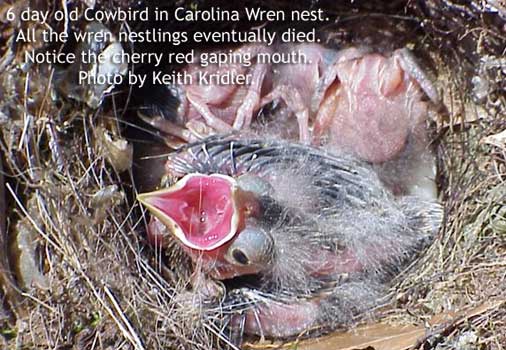
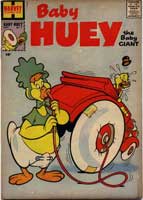
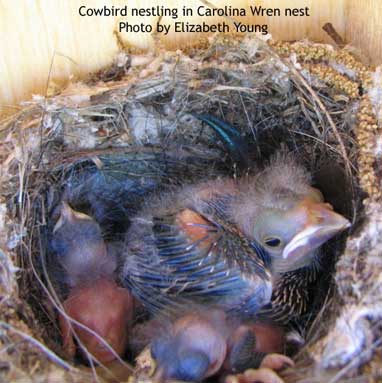
Nestling ID: Cowbird nestlings are significantly (e.g., 3-4 times) larger than the young of their host. (Some bluebird monitors equate them to Baby Huey or a Frankenbaby.) At hatching they are altricial (naked), blind, with buff colored skin (the newborn I saw had pink skin), and usually a yellow rictal flange. They have whitish down on their heads, whereas normal bluebirds have black or dark fuzz when they first hatch. Caudal feathers emerge on day 5, preen at day 9, can hop on day 11-14. Note that sometimes the host’s young can be different sizes (one much larger) due to asynchronous hatching.
The interior of a bluebird nestlings’ mouth is yellow. A Cowbird nestling has a deep pink or cherry red mouth. Apparently an indicator that a nestling has not been fed recently is blood collected around the mouth. After the baby is fed, blood is drawn to the digestive area, and the color of the mouth fades. Thus having a bright red mouth, and the ability (due to earlier hatching and larger size) to reach higher when gaping results in Cowbird nestlings receiving priority for feeding. Also, Cowbird’s eyes open around Day 2 (about 4 days earlier than a bluebird nestling), so they are better equipped to detect the presence of their adopted parents and position and beg more effectively to receive priority for feeding. Cowbird nestlings are almost always fed more than the host’s own young (Woodward 1983.)
Fledging: Cowbirds fledge about 11 (8-13) days after hatching. Although they are altricial, they have adapted to survive in open nests, and as a result probably fledge earlier than typical cavity nester young (16-21 days for an Eastern Bluebird.)Cowbird young remain dependent on their foster parents for about 16-28 (?) days after fledging. They are fed by hosts until they are 25-39 days old. Barbara Burnham observed “a tiny Chipping Sparrow frantically feeding a big fat Cowbird. She (or he) had to fly up off the branch just to reach it’s big fat beak, then rush off to find more food.”
Threat posed: Unlike the Cuckoo, Cowbird nestlings do not oust host eggs or young from the nest, or kill the host’s chicks. However, since they tend to hatch earlier, develop faster, and crowd out or reduce the food intake of the hosts’ nestlings, often only the Cowbird survives to fledging. In one study with one Cowbird and two host nestlings, the Cowbird got 50% of the food.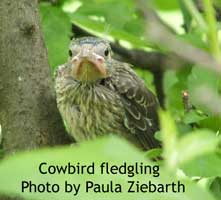 Thus Cowbirds do pose a threat to the survival of some species whose nests they regularly parasitize, especially those that nest near forest edges, close to open country preferred by Cowbirds. In the 1960’s, it was found that 70% of Kirtland’s warblers nests were being parasitized by Cowbirds. The USFWS began a program of trapping and removal. By 1980, they had removed 40,000 Cowbirds, nest parasitism dropped to negligible levels, and Kirtland’s warbler fledging rates tripled.
Solutions: Like it or not, Cowbirds are native, so they are protected under the Migratory Bird Treaty Act. This means that in most cases, eggs cannot be removed from nests without a permit. Special permits have been obtained to kill Cowbirds that congregate in enormous flocks and are considered a nuisance. In some spots in states like MI and TX, permits can be obtained to trap Cowbirds to protect endangered species like Kirtland’s Warblers. In some areas, monitors are authorized to remove eggs and trap adults after taking a class. Check on local requirements.
Other solutions include:
- Avoid offering millet (little tan round seeds in inexpensive mixes) in feeders, as it may attract Cowbirds.
- Offer mealworms as supplemental food to increase the odds that the parent birds biological nestlings survive.
- Keith Kridler found that attaching strawberry basket to a tree limb with a fake nest in it fools Cowbirds into laying. Predators soon learn where these unguarded nests are.
- Note: Some bluebird monitors toss Cowbird eggs, or remove House Sparrow eggs from House Sparrow nests and replace them with Cowbird eggs.
Flocking: Cowbirds may feed and roost in enormous flocks with blackbirds and starlings, especially in winter months. Flocks can consist of 50 – 10,000 birds (Eaton, 1914).Since they raised by other species, they do not learn how to behave like a Cowbird from their forest parents. It appears this information is mostly genetically-encoded. Therefore, a Cowbird innately knows its own song and calls, its own displays, and recognizes and mates with its own species, despite having never encountered another of its own kind before.Other names: The Brown-headed Cowbird is sometimes called a Cow-pen bird, Cow Bunting, or Buffalo Bird. Note that sometimes people refer to White Cattle Egrets as “Cowbirds.”Less is known about the habits of the Bronzed Cowbird (Molothrus aeneus). “Molothrus” is Greek for vagabond, tramp or parasite.
Song: Their song is complicated, comprised of 40 different notes. It takes an individual about 2 years to master the song.
References and Sources of More Information:
- See more photos of eggs and young
- Species Description – Cornell
- (Nest ID) A Field Guide to the Birds’ Nests: United States east of the Mississippi River (Peterson Field Guide Series), Harrison, Hal H.
- The Birder’s Handbook, Erlich, Dobkin and Wheye
- Brood Parasitism, Provincial Museum of Alberta
- Brood parasites – Signs of Spring
- Best of Bluebird_L – Cowbirds
- Life Histories of Familiar North American Birds – AC Bent – Cowbird
- UF study first to document evidence of ‘mafia’ behavior in Cowbirds
- UC Berkley News, Biologists find secret to parasitic Cowbird success: They join nest mates in making noise, then hog the food, Robert Sanders, 08/05/2004
- Nest and Egg ID (with links to species biology and photos of nests, eggs and young) for other small cavity nesters
- Egg ID matrix
- Egg size comparison
- Forest Fragmentation, ourbetternature.org
- List of victims and hosts of the parasitic cowbirds (Molothurs), Peter E. Lowther, Field Museum
- Lowther, Peter and William Post. 1999. Shiny Cowbird (Molothrus bonariensis), The Birds of North America Online (A. Poole, Ed.). Ithaca: Cornell Lab of Ornithology; Retrieved from the Birds of North America Online: doi:10.2173/bna.399
- In a Bird’s Nest, an Animal Behavior Puzzle, James Gorman, December 10, 2013, New York Times
“One of the tragicomic scenes in nature is a pair of small foster parents working like Sisyphus to keep up with the voracious appetite of an outsized young” Cowbird.
– The Birder’s Handbook
