
Contents: Species, Distribution, Diet, Nesting Behavior, Nestboxes, Monitoring, Nesting Timetable, Egg and Nest Photos, More Info
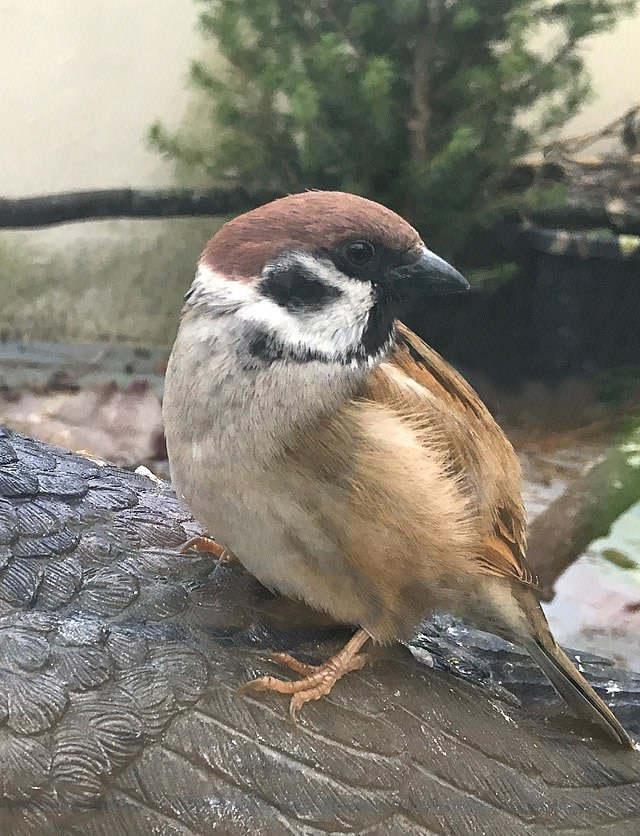
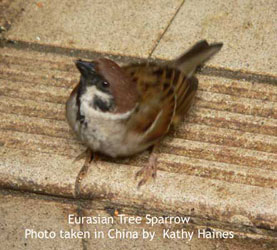 Species: Eurasian Tree Sparrow, Passer montanus, or ETSP (sometimes called the European Tree Sparrow). Both sexes look alike. The adult has a reddish brown crown (rufous cap) separated by a narrow white color, and prominent black spot on white cheeks, short black bib, and trim build.
From the front, they look like skinny male HOSP. But the male HOSP is larger, chunkier (larger head) and has a small white spot over the eye, and females don’t have a black bib.
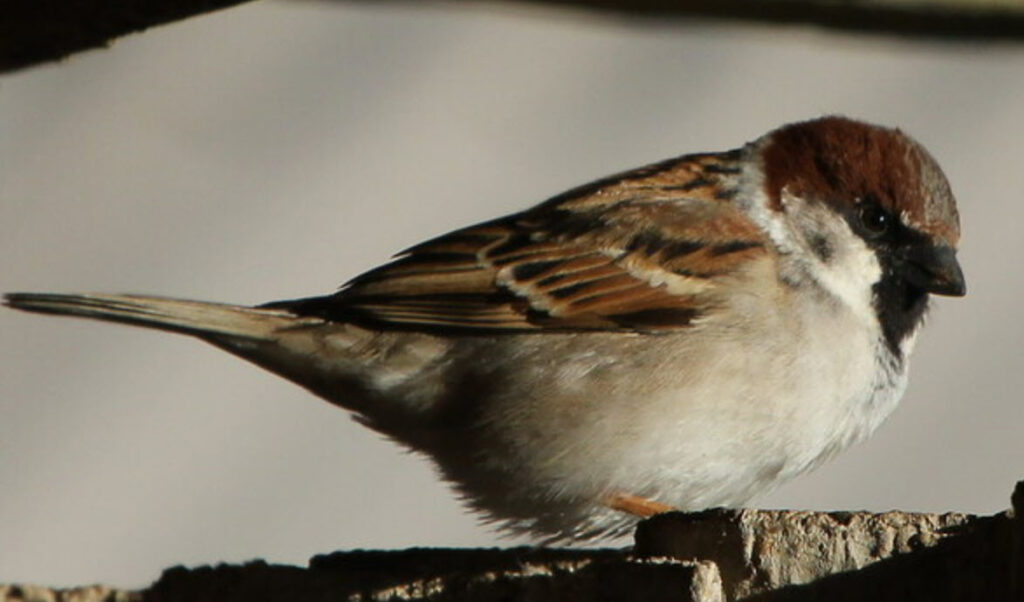
However, ETSP can hybridize with House Sparrows (HOSP). Hybrid males and females are different from each other (like HOSP). Male hybrids (Passer domesticus x montanus) resemble the ETSP, while females have more similarities with HOSP. See photo below.
Distribution: 20 birds were introduced in 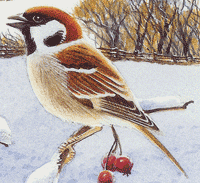 1870 in Lafayette Park, St. Louis MO by a bird dealer who imported them from Germany. Unlike HOSP, the ETSP has not spread far beyond eastern-central Missouri, west-central Illinois and southeastern Iowa – perhaps because it is less aggressive, or due to competition with HOSP. Their population in 1987 was estimated to be about 150,000 birds. (Lang & Barlow 1987.)
One bluebirder noted that after trapping and reducing the local HOSP population, ETSPs started to take over, although they did not appear to be aggressive. They tend to stay in woodlands, cultivated and abandoned fields and farms, and parks near human habitation. Like HOSP, they tend to be around human habitation, are gregarious, largely non-migratory, and socially monogamous.
UPDATE: In January 2024, I saw a nestcam video by Katharine Martin of St. Charles, MO, of an ETSP attacking a bluebird and it was VICIOUS. The bluebird exited the box, but it’s unknown if it survived as the box was not nearby. I wonder the attacker was a hybrid, but it was clearly mostly ETSP. SEE VIDEO OF ATTACK: WARNING: It is brutal, and the bluebird’s cries are upsetting.
Diet: Grains, weed and grass seeds, insects during breeding season and fruit (e.g., mulberry)
Status under the Migratory Bird Treaty Act: The focus of the Migratory Bird Treaty Act is on protecting native birds, and the ETSP is introduced. Unlike House Sparrows and Starlings, they are not specifically excluded from protection, but they are also not on the list of protected birds. Many sources, including the State of Kentucky lists them as NOT being covered by the MBTA. HOWEVER, the ETSP IS protected in the State of Illinois, under the Wildlife Code (Chapter 520 ILCS 5.) That means you can’t remove their nests, eggs or tra[adult birds.
Nesting Behavior: Secondary cavity nester. Not aggressive or pugnacious like the HOSP, but may attempt to claim a box used by another bird (e.g., chickadee). May nest earlier than bluebirds, beating them out of boxes.
Nestboxes: Does not compete well with HOSP for nestboxes unless the opening is <29 mm (<1.142 inches). Will nest in tree cavities, old woodpecker holes, cliff hole, under house eaves.
Monitoring: No information available.
- Nest site selection: The male selects a nest site between March and June. Holes are at least 3.3 feet above the ground (e.g., in a hollow fence post) to 32 feet in trees or buildings, or in dense foliage between 6.5 – 32 feet. Also nests on wall beams of barns and other outbuildings. Seen nesting near other ETSPs and HOSP.
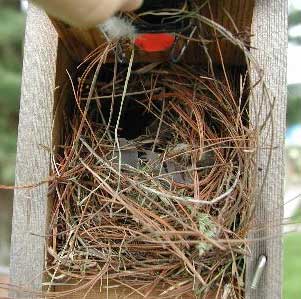
- Nest construction: Grasses, forbs, lined with feathers. Nest construction is done by both sexes, and takes about 5 days. Nest is a domed structure of loosely intertwined (not woven) stems of dried grass, straw, pine needles, rootlets and a few sticks surrounding a cup lined with softer materials such as feathers, fur, flower parts, waste paper, bits of cloth, string, and green leaves. Entrance is on side. May fill box to top. Nest materials are mostly gathered from the ground near nest site.
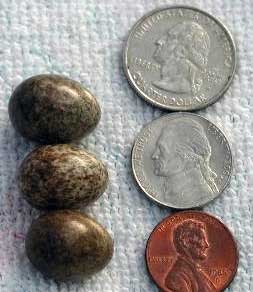
- Egg laying: 1 day to 3 weeks after nest completion. 4-7 eggs (usually 5, sometimes 2), 0.8″ long, white to pale gray, heavily marked with dark brown (sometimes purplish or grayish) spots/small blotches/speckles, darker than a House Sparrow. Markings usually concentrated around broad end. Smooth, slightly glossy. Variation in size, shape, and color, but less variation than House Sparrow eggs.
- Incubation: 10-15 days (11.6 average), usually begins day last egg is laid. Both sexes.
- Hatching: Later season or larger clutches may take longer to hatch.
- Development: Nothing to note. Both parents tend to nestlings.
- Fledging: 12-14 days (typically 14). Adults may feed fledglings for 1-2 weeks afterwards.
- Dispersal: Nonmigratory.
- Number of broods: First brood around April 20. May have two to three, starting the next clutch about a week after fledging.
References and More Information:
-
- Video of ETSP attacking Bluebird – warning: GRAPHIC
- Birds of North America, Peterson Western Birds Nests, The Birders Handbook
- Birds protected under the MBTA (list)
- House Sparrow Biology
- House Sparrow Control
- Photos below courtesy of John Curran
- Nest and Egg ID (with links to species biology and photos of nests, eggs and young) for other small cavity nesters
- YouTube video of male ETSP
- YouTube video of ETSP in nestbox, being fed by parents
Invasive alien species are the second most significant threat to biodiversity, after habitat loss.
– World Conservation Union
