
– By Bet Zimmerman Smith
My husband and sister have both asked me, “Why do people get so goopy over bluebirds?” I think there are a number of reasons why we become fascinated and even addicted to this charming creature.
- Bluebirds are beautiful. Their leisurely and buoyant flight pattern offers a slow-motion view of
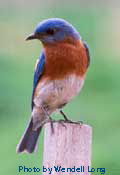 cerulean blue feathers, making it seem as though the male “carries the sky on his back.” (Henry David Thoreau)
- Bluebirds are considered harbingers of spring. As WL Dawson penned in 1903, “How the waiting countryside thrills with joy when Bluebird brings us the first word of returning spring.” John Burroughs wrote in 1880, “The bluebird enjoys the preeminence of being the first bit of color that cheers our northern landscape.” Although they may overwinter in colder climes, they actively begin house hunting in February and March, signaling better weather ahead.
- Bluebirds are associated with hope, happiness and things we love. W.L. Dawson wrote “Reflecting heaven from his back and the ground from his breast, he floats between sky and earth like the winged voice of hope.” They have probably appeared in more songs, poems and literature than any other bird. In 1909, Maurice Maeterlinck published The Blue Bird, a fairy tale about the bluebird of happiness. In 1934, tenor Jan Peerce made the Bluebird of Happiness a nationwide hit. It’s hard not to smile when hearing about “Mr. Bluebird on My Shoulder” from the Disney film Zip-A-Dee-Doo-Dah.In 1939, in the movie The Wizard of Oz, Judy Garland sang plaintively that “Somewhere over the rainbow, bluebirds fly.” One of the most famous WWII-era pop classics was a song by Nat Burton: “There’ll be bluebirds over the white cliffs of Dover, Tomorrow, just you wait and see, There’ll be love and laughter and peace ever after, Tomorrow when the world is free.”
- Bluebirds are unique to North America. Despite the reference to England in Nat Burton’s song, bluebirds are only found on our continent – thus we can call them our own.
- Bluebirds remind us of simpler times. They were not only abundant in the tunes of our youth, but also in the countryside in the days before suburban sprawl. Most of us can clearly remember our first view of that flash of blue. Because they have become less common, it is even more thrilling to see one now.
- Bluebirds are family oriented. The courting male dotes on the female, waving his wings, enticing her to select a nest site, and offering her treats. He courageously guards the box during nest construction. He delivers food to the incubating female, and participates equally in feeding nestlings and fledglings. Both parents will die defending their young from House Sparrows. After fledging, young birds tend to stay with their parents, begging for food, and sometimes altruistically helping tend to siblings in a second brood.
- Their song is enchanting. The velvety undertones are “…so soft and gentle; they sing to no one save themselves. Not loud and boastful like the mocker; not full of chatter like the purple martin. The bluebird song is a kind and personal “I love you” that one must be close and quiet to hear.” (Kenny Kleinpeter) ClydeTodd (1940) said their song, “…like the gentle murmur of a flowing brook in soothing cadence, awakens a sense of well-being and content in each responsive listener.”
- Bluebirds are friendly. They seem to almost enjoy human company. They display no fear of nesting near human habitation. They tolerate monitoring of their nests as we peek in to see their fuzzy-headed hatchlings. They quickly learn an association, whether it be a whistle or a banging door, with a mealworm feeder being filled, and instantly show up to investigate. If we do not fill the feeder in a timely manner, they may follow us around the yard, warbling away.
- Bluebirds do no harm.In the days before pesticides, farmers put up nestboxes around their fields, as they were aware that bluebirds eat many insects, and the fruit they eat during the winter is not of the cultivated variety. While bluebirds will compete for nesting sites and defend their own abode, they do not maliciously attack other birds, eggs or nests.
- Attracting bluebirds is a challenging hobby. Since the number of natural cavities has dwindled and competition from exotic species like House Sparrows and starlings is severe, bluebirds depend on humans to survive and thrive. Because of this, we feel an almost parental sense of ownership and satisfaction when we enable successful nesting. Bluebirding taps into problem solving skills and creativity, scientific curiosity, and a love of nature and the outdoors.
- Bluebirds remind us of both the bad and good humans are capable of. Almost all impacts to bluebird populations, both negative and positive, have been directly associated with human activity. On the negative side, there is the introduction of House Sparrows and starlings, pesticide use, and loss of open space. But on the positive side, grass roots conservation efforts by individuals and groups across the continent area shining example of the power we all have to make a difference.
MORE INFORMATION:
- Quotes and poems about bluebirds
- A draft history of bluebirds
- Are House Sparrows “Evil”?
- You Know You’re a Bluebirder When….
- The Downside of Bluebirding – Bluebirding Blues
