
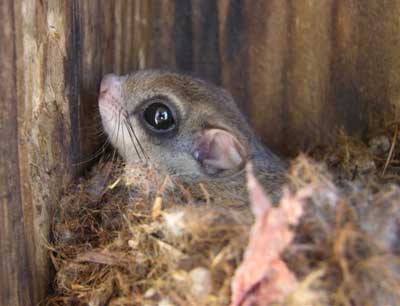

Contents: Species, Interesting Facts, Identification, Distribution, Preferred Nesting Habitat, Diet, Nesting Behavior, Nestboxes, Nestbox Location, Recommended Distance Between Nestboxes, Monitoring, Nesting Timetable, Longevity, More Info. Also see photos of nests and adults.
Species: Two species are found in North America: Northern (Glaucomy sabrinus) and Southern (Glaucomy volans). It is hard to distinguish between the two, although
- Northern adults are larger, measuring about 10-12 inches (but juveniles could be confused with adult Southern) with cinnamon /grayish/ reddish-brown or blackish brown fur.
- Southern tend to be more grayish, but color is variable, and they are smaller, at about 8-10 inches.
- Belly hair differs but can also vary (Northern has dark gray belly hair at the base tipped with a lighter color, Southern is more white.)
- DNA is the only way to tell for sure. The species are not known to interbreed.
There are two subspecies of the Southern Flying Squirrel in the southern Appalachians, the Carolina Northern flying squirrel, G. s. coloratus, and the Virginia Northern flying squirrel G. s. fuscus – both are endangered.
- They do not really fly. They glide. They steer by adjusting the tautness of the patagium (furry membrane), and use their tail as a stabilizer and to brake before landing. They can glide 80-150 feet.
- They may store up to 15,000 nuts in a season.
- Flying Squirrels are the only nocturnal tree squirrel, and are the smallest of all squirrels.
- They have been kept as pets since the Colonial era. They are very social and require a significant commitment of time from their owners. More info. Note that many states require a special permit to capture, sell or keep native wildlife.
- Northern Flying Squirrels make a low, soft chirp, and cluck when distressed.
- There has never been a report of flying squirrels having rabies. They can get typhus, but this is only rarely passed to humans. They can get lice, fleas, mites and parasites.
Identification: Small (about 8-12 inches long), large bulging eyes, flattened tail, whitish underneath. Furry membrane between front and rear legs. Males and females look alike.
Distribution: Both species are actually fairly common in CT, but are not often seen because they are nocturnal – i.e., active at night. Check range maps to see which species are in your area.
- Northern: Alaska and Canada southward in the west to northern California and Colorado, in the middle of the continent to central Michigan and Wisconsin, and in the east to northern North Carolina and Tennessee. Small populations exist in areas of high elevation in other parts of the U.S., including the southern Appalachian Mountains, Black Hills, and Sierra Nevada (Animal Diversity Web). Prefer older coniferous forest.
- Southern: in the eastern half of North America, from southeastern Canada to Florida, and south as far as Mexico and the Honduras. Prefer older deciduous forest, often along streams and near wetlands.
Preferred Nesting Habitat: Found in coniferous and mixed forests (especially those that produce mast [nuts] such as maple, beech, hickory, oak and poplar), with a good tree canopy overhead. May avoid areas where wood has been recently harvested. May den in houses (attics) or barns.
According to Keith Kridler, Flying Squirrels require a large wooded area where trees are spaced close enough to allow them to sail through the area without spending much time on the ground.
Diet: Fond of hickory nuts and acorns, peanuts, pecans and sunflower seed. Prone to calcium deficit in captivity.
- Northern: Fungi, lichens, mushrooms, hardwood mast (nuts – except walnuts because the shell is too hard), tree sap, insects, carrion, bird eggs and nestlings, buds, and flowers, bird seed.
- Southern: insects, mast, fungi and mushrooms (esp. truffles), carrion, buds, flowers, bird eggs and nestlings, seeds, berries, fruit, insects, slugs and snails, bark, young mice, tree sap, carrion (esp. in winter). May cache food for winter use.
Nesting Behavior: Flying squirrels may have:
- “refugia” nests (shelters or “dens” for daytime (often 8-20 feet high, in cavities with entrance holes measuring 1.5-2″) – this is typically what I see a standard bluebird box used for.
- “dreys” that are not in cavities (used during warmer months)
- “natal” nests (used to raise young – usually more voluminous)
- “aggregate” nests (shared with related or unrelated individuals during winter)
- “defectatorium” (den used exclusively for defecation). Humus can build up to 1.5 feet (enature.com)
- “food cache” I have also seen boxes filled with acorns that seem to just be for food storage.
They live in loose colonies, and the previous years’ young may live in the same boxes with adults and young from the current year. They may be in a nestbox any month of the year. When not rearing young, may shift from nest or nest, or share nests to stay warm in cold temperatures (since they do not hibernate). Northern squirrels have a clean nest. Southern squirrels are less fastidious and may soil their nest, and bring food into denning nests.
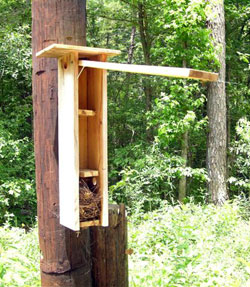
Nestboxes: Usually nest in abandoned woodpecker holes and natural cavities in snags, but occasionally use a bluebird nestbox. They may use regular nestboxes or gourds. They often occupy owl nestboxes.
They have been known to evict smaller birds, and eat the eggs and nestlings of of other cavity nesters, and kill adults. (see Predator/Problem ID.)
Kridler indicates flying squirrels:
- can enter a box with a 7/8″ slot
- adults can enter a 1.25″ round hole though a pregnant female may find this tight.
- seem to prefer a hole small enough so a gray squirrel and predators can not enter.
- may prefer a box with a 6×6″ floor, 8-10″ deep (so the overall box is about 32″ tall), with a hole-to-floor depth of 6-8″, 1.5 to 1& 9/16″ hole, mounted 10-26′ high.
- Bluebirders have had them in Gary Springer Chalet nestboxes with a 4×5″ bottom mounted 9 feet off the ground on conduit, hollow log nestboxes with a 2.5″ round interior, screech owl boxes mounted 10 feet high on a tree trunk, and Carrier nestboxes (which were thought to be sparrow resistant, but are not) attached to tree trunks.
- On the East coast, I have seen them in boxes mounted on poles (metal or telephone) and trees, and in NABS boxes, and 2 hole Mansions hanging from a hook in a tree.
Kridler’s specs for tall, multi-level box shown in photo, made from 1×6″ or 1×8″ boards. When a family moves in, the female or adults will stay in one compartment, teenagers in another, and babies in the third. If you build one with four compartments, they may use the extra one as a defecatorium (bathroom.)
- Two sides are 32.5″ x 6.25″ wide
- Two sides are 32″ long to allow for a 0.5″ tall air gap
- Front side that opens is 32″ long x 4.75″
- Floors are 4.75″ square. (Keith has also made boxes with 6″ square floors, depending on the size lumber available.)
- Roof can be 1×6″ with some overhang over the top entrance.
- There are three compartments inside of the box, each about 10″ tall
- The lower compartment has the entrance hole on the left side
- Entrance holes are 1.5″ round, and can be as small as 1.25″ but that could be tight for pregnant females.
- For escape holes (e.g., for snakes) between floors, cut a 1.5″ square corner off the floor of the second compartment and the top compartment, lining them up facing one corner of the door side that opens.
- There is another 1.5″ round exit/entrance hole in the top compartment on the right hand side
- Entrance holes are located 6 to 7″ off the floors of the compartments they are in
Nestbox Location: In preferred habitat with tree cover. Try 8-20 feet high. Keith Kridler of TX has found them nesting in boxes on telephone poles about 150 feet from the nearest tall tree. Their movements on the ground are awkward, so they probably prefer to be able to glide to the nest location to avoid predation. He has the best luck in open woods with boxes on trees that are six inches or less in diameter, or on a power pole on the edge of the woodlands or in a cleared right of way. (Ask permission before mounting boxes on utility poles.)
Recommended distance between nestboxes: Kridler recommends putting 3-5 nestboxes scattered in a five or ten acre area, and then another 3-5 boxes in about 10-20 acres distant (about every mile or so.) Animal Diversity webs says home ranges are 0.5-1.5 hectares, male ranges overlap, female ranges do not overlap with ranges of other females. Wikipedia.org says home ranges are up to 40,000 square meters for females, and 50% higher for males (Wikipedia.org).
Monitoring: If you suspect flying squirrels are using a nestbox, tap on the box, and they will usually peek out the hole or scamper out. Opening the door may cause them to abandon the box. Do NOT push your hand inside the nest, as they may bite. If you really want a count, poke or prod the nesting material with a stick to get them to shift location.
You may find a single individual or 6-9 in one box. Squirrels may disappear for a couple of months at a time.
Hygiene is generally not good (boxes fill up with trash or feces), so clean them out when the boxes are vacated (which may be every two years or so.)
Bumblebees may inhabit old flying squirrel nests.
- Excavation or nest site selection: See above. Secondary cavity nesters (do not excavate their own nest.) Females may be territorial and defend nest sites? Males are not allowed near the natal nests?)
- Nest construction: Unlike a typical bird nest, there is no “nest cup” on top. Construction depends on available materials. Northern: grass, shredded bark (e.g., cedar, grape, birch, cypress), moss, lichen, feathers, found animal fur, feathers, small twigs, leaves and conifer needles, and man-made materials like attic insulation or newspaper. In summer, may use a leaf nest for “roosting.” Solitary male nest is much less bulky than a natal nest. Southern: lined with shredded bark (Eastern Red Cedar, Bald Cypress) or, in the Deep South, Spanish moss and palmetto fibers.
- Gestation: Approximately 40 days.
- Birth: Northern: 1-6 per litter (2-4 typical); Southern: 2-7 per litter (2-3 is common), born in early spring or mid-summer. Early on they are fed milk, then soft things like insects and tender twigs.
- Development: Young born without fur, eyes and ears closed, fused toes, cylindrical tail. Ears open at 2-6 days, by 6 days toes are separated, fur starts to grow in by 7 days. Eyes do not open until 24-30 days old. See details on Northern or Southern at flyingsquirrels.com They begin to molt to their first adult fur at about 84 days (12 weeks.)
- Leaving nest: Young stay with their mother for 4 to 5 months, and some stay with them through the winter. Northern: leave nest at 40 days, weaned after 2 months. Southern: Weaned at 65 days.
- Dispersal: Fully independent at 4-6 mos. (Northern – 88 days, Southern – 84 days)
- Number of litters: Northern one litter. Southern may produce two litters per year. In the Pacific Northwest, Northern Flying Squirrels breed once a year in May or June.
- Longevity: Probably about six years in the wild, 10-15 years in captivity. Mating usually at 12 mos. (as young as 9 mos.) Sub-adults are preyed on by arboreal snakes, nocturnal owls, raccoons, martens, fishers, coyotes and house cats.
References and More Information:
- Nest and Egg ID (with links to species biology and photos of nests, eggs and young) for other small cavity nesters
- Predator and Problem ID
- Flying Squirrel photos (adults and nests), Sialis.org
- Flying Squirrel Bio, Sialis.org
- In my experience, flying Squirrels seem to like large hanging boxes with two entrance holes – Linda Violett’s two hole mansion plans
- Flying Squirrel in nestbox – video clip
- Flying Squirrel eating – video clip
- The Hill Trail (in CT, where this box is located)
- Hill trail log with photos
- Flying Squirrel Central – just links about flying squirrels and photos
The trees and the trunks are their flying trapeze
– Bet Zimmerman
