
What Happened? See Guides organized either by Clue, or by Culprit with Solutions. Also see Predator Baffle and Battle Photos. Also see Comparing Pros and Cons of Various Predator Guard Styles
QUICK TIPS: It is impossible to prevent all problems or predation. However, there are some things you can do to prevent problems and increase the odds that “your” nesting birds will survive. If something goes wrong, don’t give up! Try to identify the culprit and prevent recurrence. Use well-designed nestboxes that are sturdy, have the right size hole, a large overhanging roof, will stay dry inside, and can be opened for monitoring and cleaning. If boxes are in House Sparrow territory, put a sparrow spooker up after the first egg. Move boxes out of House Wren habitat or use a wren guard after the first egg. Protect against climbing mammals and reptiles by mounting the nestbox on a pole with a predator guard. And then hope for the best!
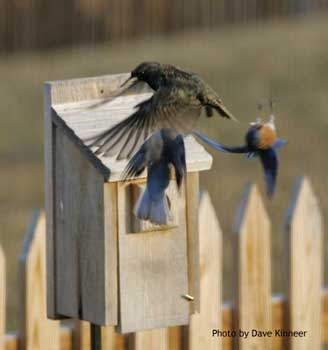 It’s a cruel world out there. About 55-84% of Eastern bluebird nesting attempts fail (Radunzel et all 1997.) But we usually don’t get to witness it first hand like we do in our backyards or on a bluebird trail.
It is virtually impossible to prevent all problems and predation. However, there are some things you can do that will dramatically increase the odds that birds you invite to nest in your yard will survive and thrive.
When something does go wrong, it’s important to try to figure out what happened so you can try to prevent it in the future. Methods that work really well for some predators (e.g., sparrow spookers for House Sparrows) will have no effect whatsoever on other culprits (like House Wrens.)
The following can cause problems in a bluebird nestbox: ants, blackflies/gnats, blow flies, cats, House Sparrows, fire ants, House Wrens, mice, nestbox design, pesticides, raccoons, rats, red squirrels, snakes, starlings, starvation, wasps, cold or hot weather, and woodpeckers. Bolded predators/problems are the most common.
Occasionally, problems may also be caused by automobile, bears, bees, bluebirds, blue or scrub jays, chipmunks, cowbirds, crows or ravens, disease or internal parasites, feeding earthworms, flickers, flying squirrels, fox squirrels, grackles, gray squirrels, ground squirrels, hawks, honeybee, human vandals, lightning, magpies, mites, opossums, owls, intestinal parasites, skunks, Tree Swallow, violet-green swallows, weasels, west nile virus, window strikes and Yellow Jacket wasps.
When trying to identify the culprit, consider the method of nestbox mounting (e.g., tree vs. pole), whether there is a predator guard properly installed, entrance hole size, distance from bottom of hole to nest cup (predator reach), competitors (e.g., starlings, House Wrens, House Sparrows) or predators (snakes) in your area, immediate environment around nestbox, and general environment of the surrounding area (e.g., agriculture involving pesticides), the type of damage done, time of year, and other clues (claw marks, fur, feathers, disturbed nest). In some cases without a video camera trained on the nest 24/7, you will never be able to determine what happened.
Also see Nest and Egg ID, dead Tree Swallows in nestbox, How to find a wildlife rehabber, emergency baby bird care, Competition among Cavity Nesters, Widows/Widowers/Orphans, and Bluebirding Blues – the Downside. Input or corrections on the information here is welcome!
GUIDE – CLUES: Possible Culprits
GUIDE: POSSIBLE CULPRIT: Clues and Solutions
| PREDATOR/ PROBLEM |
IDENTIFICATION CLUES | POSSIBLE SOLUTIONS |
| Ants | Ants in box. (Also see Fire Ants.) Adults may abandon box, nestlings may be dead. | “Terro” on Q-tip stapled under box, careful use of Tree Tanglefoot Pest/Insect Barrier under baffle, or vaseline on pole. Remove old nests and dispose in trash. Diatomaceous earth under nest, Amdro ant bait placed weekly in a.m. by base of pole. More. |
| Automobile | Dead adult found in road/roadside, widow/widower, nest abandoned | Relocate nestboxes away from busy roads, face nestbox entrance opposite from or parallel with road |
| Bear (Black – Ursus americanus) | Nestbox destroyed (torn up/mangled, claw marks often visible). Contents (esp. eggs and unfeathered nestlings) may be consumed. Pole bent (may have been perceived as a bird feeder.) | Try hanging boxes. Remove bird feeders when bears come out of hibernation. Put a “dose” of “Peanut Pepper” right in front of the nestbox post on the ground and repeat 2x/week until young fledge. More. |
| Bee (Bumble) (Bombus sp.) | Nest abandoned (typically chickadee or titmouse, or old mouse nest , occasionally bluebird, flying squirrel), bumblebee buzzing inside nest or flying around. There may be a ball of pollen with eggs and a “honeypot” (about 1/4 size of chickadee egg, popped open on one end.) See photos.
Do not confuse with Honey/Africanized Bees and or Paper Wasps |
Put nest with bumblebee, pollen ball and honeypot on the ground (away from the box.) May need to put plastic bag over box and scare bee out into it first. Or put up another box and let the bumblebee stay. Or eject the bumblebee from the nest, and poke around in the middle of the nest with a stick or a pencil to destroy the honeypot. Chickadees generally will not return to a failed nest site so may not come back to use the nest if they can find another cavity. |
| Bee (Honey or Africanized) | Swarm may move into box, especially larger boxes (e.g., Wood Duck). Do not confuse with Bumblebees or Paper Wasps.
Note: If you live in an area known to have Africanized bees, immediately seek a professional for safe and proper removal. Otherwise, suit up, take down the hanging box and put in an inexpensive laundry “tent” bags that folds or bag with tight Velcro strips sewn on the openings. |
Move boxes away from mother colonies or places where bees are released. Brush dishsoap onto the interior nestbox roof and upper corners. Fluffy polyester batting attached with DAP silicone caulk to the ceiling and sealed in the corners may help. Avoid large two-holed boxes hanging high in trees? (Multiple holes may also make it more awkward to contain bees while lowering).* Put box lower (below 10 – 15′) if they are high up or hanging? Remove swarm. |
| Blackflies/ Buffalo/Turkey Gnats (small biting and blood-sucking flies that tend to swarm) |
Nestlings dead in nest, numerous little black flies around, red welts/lesions on body especially under wings, adult flies in ear canals. (These insects typically live for one month in the spring [especially with a lot of rainfall] and die when temperatures exceed 80 degrees. A serious pest in some parts of the midwest.) The bite can cause an allergic reaction. They tend to bite on sunny windless days. | Spray inside of box with Pyrethrin (every 2-3 days) Flys Away II regularly until nestlings are 12-13 days old. Try nestboxes without ventilation holes (may not prevent death) or stuff ventilation holes or slots with Mortite caulk or cotton, or cover with duct tape (on the outside) or fine screen folded on itself. Remove or replace dirty nests. Apply Tree Tanglefoot Pest/Insect Barrier around the exterior edges of all vent holes, but NOT near the nestbox entrance where it could get on birds and kill them. Do not locate boxes near fresh running water. Do not use dark colors on outside of box? More. |
| Blow flies | Nestlings dead in nest, red welts on bodies, grayish white maggotty looking things or black pupae under nest. Large numbers (>10 per nestling). Death rarely caused by blow flies alone – may be associated with other problems such as lack of food/cold wet weather/disease, etc. | Lift nest out with young and brush out larva. Keep box interior dry. If nest is wet with lots of pupa, replace nest. More. |
| Bluebirds (Sialia sp.) | Eggs of another species (chickadee, Tree Swallow, missing), bluebirds going in and out, or bluebird nest later built on top of another nest. (More likely to be competitor or usurper.) When a mate is lost, a new mate may not feed the prior mates’ young, may remove eggs, or may remove or kill nestlings. | Use a hole restrictor to protect nests of smaller birds (titmouse, chickadee). Put up another box 5-20 feet away, or even more than 300 feet for very territorial pairs. More. |
| Blue Jay, Stellar or Scrub Jay (Cyanocitta sp.) | Eggs or unfeathered chicks (3-5 days old) missing. May take mealworms from feeding stations or attack adults. See Magpies. | See Magpies. Remove feeders attracting jays. Use bluebird feeder (1.5″ holes or wire cage) that does not allow access to larger birds. |
| Cats (Felis catus) | Nestlings disappear, nest messed up (usually not pulled out of hole), grass below may be trampled, feathers in vicinity. Dead adults (missing or matted feathers or wounds, broken neck, scattered feathers; if eaten tail and wings usually left behind) – may be grabbed as they exit cavity. Eggs usually not taken (can not take out individual eggs), may be broken. Possibly very thin scratches (made by sharp claws) on roof, cat fur (one color, no bands) on roof edges. | Use box with large overhanging roof (5″). Do not mount on trees or fence posts/lines, use Noel Guard, or PVC or stovepipe predator guard on pole, boxes with large overhanging roof. Mount 5-6+ feet high or use hanging boxes, keep cats indoors, trap feral cats. Any bird handled by a cat (may have missing or matted feathers) should be rescued immediately. More. |
| Chipmunks (Tamias spp.) – including Eastern, and gray-necked, yellow-pine and Townsend for WEBL | Eggs broken in nest or on ground. Nestlings partially eaten or missing, corpse(s) may be incorporated into nest. Box may be filled with chewed bark and leaves. | Mount box on pole with predator guard (e.g., stovepipe) |
| Cold wet weather | Young nestlings dead in nest, may be starved, nest may be wet after extended period of cold, wet rainy weather. (Note: larger nestlings – e.g., with pin feathers – may actually be more susceptible to hypothermia as female can not completely cover and warm them with her body. However, bluebird nestlings can thermoregulate by day 7-8.) Wet nesting material can cause fungal infections. Nestlings parasitized by blow flies may be more susceptible. Adults may be found dead in a nestbox/roostbox during the winter. | Face box entrance hole away from prevailing wind. Caulk cracks or replace leaking box. Temporarily cover vent holes. Replace wet nest. Offer mealworms. Leave up nestboxes or provide roosting boxes during the winter. Plant shrubs that provide berries in fall/winter. More. |
| Cowbird (Molothrus ater) | One different egg (and one original egg missing) in with others (white with spots – see description). Occasionally egg removed and no cowbird egg laid. One nestling larger than others with deep pink or cherry red mouth, other babies starving, dead or missing (removed by parents). | Measure entrance hole (1 1/2 – 1 9/16″ round or 1.375″ x 2.250″ oval hole), put hole restrictor on if enlarged. Technically it is illegal to remove eggs of cowbirds as they are native birds. More. |
| Crows or Ravens (Corvus sp.) | Nestlings (possibly some but not all) removed. Eggs missing? | Large overhanging roof, deeper box, wooden face guard, lower nest to 4.5″+ below entrance hole. Remove used nests so bluebirds don’t build on top, making nest too high. |
| Deformity – typically beak or legs | Elonged, weirdly curved or twisted beak. Splayed or twisted legs. | Cause? genetic, a nutritional defiency, an environmental contaminant such as selenium or an organochloride, or an injury during development? Erect boxes away from areas where pesticides are commonly used. Remove unhatched eggs from boxes. Offer calcium supplement when feeding mealworms. |
| Disease (e.g., bacterial infection)/Internal Parasites (e.g., intestinal worm) | One or all nestlings dead in box, no sign of injury, nest dry and clean, parents still around. Dead adults in box with no sign of trauma/injury (Maggots may feed on corpses.) | Cleaning out the box after each nesting MIGHT help prevent transmission. Salmonella or E.Coli may kill. Offer clean water. More. |
| Earthworms | Nestlings dead, muddy “fecal glue” in nesting material (if you wash it out, may find pieces of earthworms) | Parents desperate for food offered earthworms. Do not offer earthworms, do offer mealworms. |
| Eggbound female | Dead female on nest | Do not feed too many mealworms, or dust them with calcium supplements. Add calcium to suet/birdseed. More. |
| Egg Eating | Missing eggs, female seen eating eggs on camera. | Remove any broken eggs and contaminated nesting material. Supplement calcium if feeding mealworms, and protein via suet. |
| Fire Ants (Solenopsis spp.) | Nestlings dead or reduced to skeletons (including head) in South. Swarm over them and eat them alive. Adults will not enter nestbox. | “Terro” on Q-tip stapled under box, Tree Tanglefoot Pest/Insect Barrier under baffle, vaseline on pole. Destroy old nests. Apply either Amdro or Logic fire ant killer (bait type) within about 10 feet of the box. Spot treat large mounds. More. |
| Flicker (Colaptes auratus) | (All?) eggs pierced but not removed or eaten. More likely in Wood Duck Boxes which have a larger entrance hole. | See Magpies to prevent predation in bluebird boxes. |
| Flying Squirrels (Glaucomys volans and G. sabrinus) – nocturnal | Eggs missing – usually broken eggshells in nest or at least some egg yolk/white. Nestlings partially eaten or missing. Dead adults (bites around head and neck/breast meat eaten, normally smaller feathers pulled out.) Nest may not be disturbed. Box taken over, filled with grass/leaves. Acorns in box. Flying squirrel sitting inside, or comes out of box when opened. Can enter a 1.25″ hole. Mostly likely in boxes in, on or near trees. | Mount boxes on metal pipe with grease on the pole and about 100 feet away from the nearest tall tree or power pole. Mount owl boxes on the edge of a wooded area, or find a tree that at least 10-15 yards away from the woods. Use metal hole protectors to prevent enlargement of entrance. Leave door open if you want squirrels to abandon before having young, then remove nest. Caution: Flying squirrels may bite if you push your hand into nest. Use long handled putty knife or bee keepers hive tool. More info. |
| Fox Squirrel (Sciurus niger) | See Red Squirrel. Esp. threat to kestrel boxes. | Reduce chewed hole to (1 1/2 – 1 9/16″ round or 1.375″ x 2.250″ oval hole) with hole reducer or new door. |
| Gnats | see Blackflies | |
| Grackle, Common (Quiscalus quiscula) | See Magpies. Also possibly decapitated bird. | See Magpies. |
| Gray Squirrels (Sciurus carolinensis) | See Red Squirrel. Generally prefers a 4″entrance on the side, 10×11″ floor, 24″ deep box for nesting. | Reduce chewed hole to (1 1/2 – 1 9/16″ round or 1.375″ x 2.250″ oval hole) with hole reducer or new door. |
| Ground Squirrel | Eggs missing, partially eaten nestling(s) or missing nestlings | See chipmunk. |
| Hawks, including Kestrels (Falco sparverius), Cooper’s (Accipiter cooperii, Sharp-shinned (A. striatus), Swainson’s (Buteo swainsoni). Red-tailed (Buteo jamaicensis) unlikely. | Brittle (old) nestboxes torn apart. Missing nestlings (possibly some but not all, esp. up to 9 days old), lots of feathers on the ground and/or primaries left in the box. Kestrels on or near boxes.
Fledglings taken on first flight, or fledglings or adults taken at feeders. (Note: Kestrels may take up to 6 day old nestling through 1 3/4″ hole.) Missing adult, lots of feathers from breast around (as they generally eat organs first) |
Measure entrance hole (1 1/2 – 1 9/16″ round or 1.375″ x 2.250″ oval hole), put hole restrictor on if enlarged. Add wooden block over hole, or Noel guard, use deeper boxes (8.5″ from bottom of hole to floor) with kerfs on interior to enable fledging, or lower nests to 4.5″+ below entrance hole. Place boxes away from known hawk nesting sites, and from power lines or other perch/divebombing spots. Replace nestboxes with sturdier ones. Locate feeders where there is some overhead protection from divebombing; consider minimizing feeding when fledglings are out. |
| Hot weather | Eggs do not hatch. Nestlings (typically 1-5 days old) dead in box – skin may be orange/yellow (vs. pinkish). Temperatures inside box in excess of 105 degrees F. | Places boxes in shade, add ventilation, add heat shields, use double roof or other shading. Try a TX BBS box with continuous slot where the soffit overhang meets the wall. More. |
| House Sparrows (HOSP, Passser domesticus) | White noodle shaped feces on nestbox roof, male HOSP perching on roof. Eggs suddenly disappear, or eggs are broken in nest or on ground near box or under bush. Small nestlings (few days old up to feathered) on ground near box. Nestlings or adults dead in box, with eyes pecked out or head wounds and small feathers may be pulled out, or nestlings with broken necks (from shaking?) House Sparrow nest may be built on top of corpse. More descriptions (graphic) | Sparrow spooker after first egg is laid. Try fishing line on boxes, PVC or slot boxes, remove food sources or use Magic Halo on feeders, remove nests and eggs or render eggs infertile, trap. More. |
| House Wrens (HOWR, Troglodytes aedon) | Eggs disappear but nest is undisturbed, or there are two tiny or one large jagged hole in eggs which are on the ground nearby (e.g., directly underneath the box by the entrance hole) or under bush or in nest; very young nestlings (up to 4-5 days old) missing or found outside of box, nesting material may be removed completely and then sticks added, or box is filled up with sticks on top of other nest. Rarely death of adult bird (head and upper areas defeathered /bloody/small puncture wound). Egg destruction may account for 1/3 of predation (Pinkowski 1977) | Use wren guard after first egg is laid, move boxes 200-300 feet away from brush, avoid crowding single boxes 100 feet to 100 yards apart. More. |
| Human Vandals (Homo sapiens) | Box and/or mount destroyed, shot, or missing; door open (screw removed/loose), entire nest missing, no traces of eggs or bird remains, garbage inside box, entire nest on ground wtih broken eggs. Perhaps signs like BB pellets on the ground, cigarette butts or candy/food wrappers, fresh soda can tabs, broken glass, grass beaten down around box. | Hanging boxes, use hex or Phillips head screws to close, signage on box (e.g., Nest protected by federal law), move boxes away from human traffic or out of reach, inform police, public relations. More. |
| Infanticide by same species | Adult (not the parent) of same species kills young – usually happens when neestlings are less than 5 days old. Nestling (Tree Swallow) may have puncture wound behind eye, or head crushed and head and back lacerated/bruised (Purple Martin) – dead may be in nest or on ground underneath. | Known to happen in Barn and Tree Swallows. Nothing can be done, other than perhaps spacing boxes farther apart to reduce terrtitorial behavior. |
| Jays – see Blue Jays | ||
| Lightning | ?All nestlings dead, bodies scattered in box, positions strained and distorted with legs extended straight, feathers erect and flared from skin, heads twisted at unusual angles after a severe lightning storm.? | Probably rare, could occur from lightning traveling along a barbed wire fence or ground. Avoid metal box, or box touching wire fence? (Postulated by Susanne Maidment, Bluebird Summer 2018) |
| Magpies (Pica pica) | Eggs missing or broken on ground. Nestlings missing (maybe only one or two – including nestlings close to fledging that are sticking their heads out of the entrance hole – Magpies reach in from roof top). Magpie may enlarge hole. | Ample roof overhanging entrance hole (install 30 gauge sheet flashing metal width of roof, extending out 5-7″ over front edge of nestbox – collapses when predator steps on it and then bounces back (do not use aluminum flashing.) Eliminate perches including latches. Measure entrance hole (1 1/2 – 1 9/16″ round or 1.375″ x 2.250″ oval hole), put hole restrictor on if enlarged. Add wooden face guard/block (1 1/2 to 2 1/4″ thick) over hole, lower nest to 4.5″+ below entrance hole, use deeper nestbox (8.5″ from bottom of hole to floor) with kerfs on interior to enable fledging. Remove used nests so bluebirds don’t build on top, making nest too high. |
| Mice (Peroymscus spp. or Microtus spp.) | Mouse nest (box filled with grass, leaves, scraps of paper and cloth, feathers, fur) in box, mouse leaps out of box when opened or is underneath nest, eggs eaten or missing or broken eggshells, chewed (esp. legs and wings) or dead nestlings. May not eat eggs and just usurp box. Strong ammonia smell after roosting during winter. | Leave box open or plugged in winter. Remove nests. Add predator guard. Take care of Hanta Virus – do not breath dust or detritus from box! More. |
| Mites (Acarina) or Lice | Numerous tiny black or red dot-sized bugs crawling in nest/on babies, especially in Tree Swallow nests. Adults may act alarmed. Birds fledge prematurely (esp. martins). Not common on bluebirds. | Provide TRES with clean feathers for nesting, do a nest change, or use a low-level (0.03 – 0.1%) of Pyrethrin pesticide, under nest. Burn used nests. Take care not to transfer mites to other nests on your hands/clothes. |
| Nestbox Design | Eggs don’t hatch, babies die in box. Dead adult Tree Swallow in box. | Boxes should meet NABS specs with adequate ventilation and shading for heat and insulation from cold. Do not use very deep boxes that babies can not fledge from. Add kerfs below entrance hole. Avoid/plug decorative boxes. |
| Opossum(Didelphis marsupialis) – nocturnal | See Raccoon. Also box chewed up (esp. plywood). | See Raccoon. |
| Owls- nocturnal (including Northern Pygmy-owl, Northern Saw-whet Owl, Screech Owl) | Decapitated birds, usually after Labor Day. If they can get the whole bird, may pull it to bits, the wings and tail being plumed. The entrails are usually eaten first and then the breast piecemeal. | Uncommon? Use box with large roof overhang? |
| Parasites (intestinal) | See disease. Dead adults, tapeworms or thorny-headed worms identified in autopsy. Adults feeding sowbugs due to limited food supply. | See disease. |
| Pesticides | Nestlings or adults suddenly dead in box, bodies unmarked (no visible signs of trauma), stomachs full, parents may still be in area. Nest dry and clean. Manicured lawn, crops/golf course nearby. Deaths in other nearby boxes. Especially for 2nd or 3rd nestings. | Try to determine if poisons will be used in area – if so, plug boxes to prevent use. Talk to farmers/golf course owners about pesticide use, ask them to avoid use around boxes. Use alternative pest control in your own yard. |
| Raccoons (Procyon lotor) – nocturnal | Eggs or nestlings gone, nest partially pulled through hole (may remove entire nest in slot box) or nest mildly disturbed. Feathers or bits of eggs on ground. Out of reach eggs may still be in box, perhaps broken. Incubating female gone with eggs broken, feathers on ground (tail and wings not usually eaten). Flimsy box torn apart. Single pieces of stiff hair with bands of colors on roof or edges of entrance hole. Claw marks (made by dull claws) on sides/roof, or mud/paw prints on box, loose screw/nail removed to open box. Especially near water/during droughts, or boxes on trees/fence with no predator guard or even with a cone guard. | Use box with large overhanging roof (5″). Do not mount on trees or fence posts/lines, use Noel Guard, or PVC or stovepipe predator guard on pole. Mount 5-6 feet high. Heavily and regularly grease poles, mix grease with red cayenne pepper. On lightweight hanging boxes, ensure hook is fairly tight or has curve at bottom. Make sure roof/door is screwed shut. More.
A deeper nestbox might also help. See Magpies. |
| Rats (Rattus rattus) | Eggs or nestlings missing. Rodent droppings, entrance hole chewed, disheveled nest that may have bits of nut shells, hair and fur. | Leave box open or plugged in winter. Use stovepipe guard. Remove nests. More. |
| Red Squirrels (Tamiasciurus hudsonicus) | Eggs missing or broken in nest or on the ground, nestlings partially eaten in nest or missing (possibly one per day), occasionally dead adult. Hole (or interior) gnawed and enlarged, box may be filled with chewed bark and leaves, acorns in box. Nestling corpses may be incorporated into nest. Esp. boxes mounted on trees/fence post/fence line. | Leave box open or plugged in winter. Use hole restrictor to prevent chewing and widening of hole. Add predator guard. Do not mount box on tree, wooden post or fence. Place box 10 feet from fence or jumping off point. Red squirrel is most carnivorous squirrel. More info. |
| Road Runners | Missing adult or baby. | May predate from roof – use larger overhang. Also see Magpies. |
| Skunks (Spilogale putorius and Mephitis mephitis) | ? | See Raccoon. |
| Snakes, esp. Black Rat (Elaphe obsoleta). Also Black Racer (Coluber constrictor), Bull (Pituophis melanoleucus), Speckled Kingsnake (Lampropeltis getula holbrooki), Corn snake (Pantherophis guttatus guttatus), Racer (Black or Blue, Coluber constrictor) Occasionally Coach-whip (Masticophis flagellum), milk (Lampropeltis doliata), garter (Thamnophis sirtalis). Rarely Copperhead (Agkistrodon contortrix) in box on tree/fencepost. Gopher/Bull (Pituophis sp.), Rubber Boa (Charina bottae) and Bull snakes for boxes on poles. Garter snakes. | Nest intact, but usually all (possibly some) eggs (egg numbers go down and up over time) or nestlings (esp. unfeathered, and those near fledging) suddenly gone, female missing, or parents still around, snake found in box. No traces of eggs shells or nestling remains. MAY find snake feces (little round or egg-shaped balls with tightly compressed hair or feathers, usually smaller than a bluebird egg.) In TN, may account for about 1/3 of nests predated (Laskey 1946.)
Esp. in South, and areas where mice are common and near wood edges, and boxes without snake-proof guards or on fence rows. (Large snakes can get over 24″ diameter cone guards) Rat snakes may prey on nests day or night. |
Use a stove pipe baffle/Kingston Guard or Krueger Snake Trap, or a five foot length of 4″ PVC sitting in a one foot diameter circle of clean sand. Keep grass and brush trimmed around pole. A Krueger snake trap is another option. More.
Do use caution when opening and checking nestboxes in snake territory – do not put your hands where you can not see – use a telescoping mirror instead (mostly people get hurt falling over from the surprise of finding a snake curled up inside a box.) See more about snakes as predators |
| Spiders | Dead nestling. Oregon Long Jumper documented as attacking a chickadee nestling which died the next day (the adult removed it) | Probably nothing you can do. |
| Squirrels (Sciurus and Tamiasciurus spp.) | See Red | Flying | Gray | Ground | Douglas squirrels may also use nestboxes. |
| Starlings (Sturnus vulgaris L.) | Eggs missing (may be yolk/white in nest, eggshell fragment below box) or nestlings missing (including nestlings close to fledging that are sticking their heads out of the entrance hole). Older nestlings may have pulled nesting material out with them while being taken from the box. Dead chicks lying on the ground nearby (not eaten). Young unfeathered chicks still in the box may have small round reddish bruises (evidence of beak jabs) on head or skin; they will be terrified during monitoring and “crawling” up the back of the box. Other birds nesting material may be removed. Starlings may not nest afterwards, but if they do, nest of coarse grass mixed wth green weeds. Eggs robin sized but lighter blue. | Measure entrance hole (1 1/2 – 1 9/16″ round or 1.375″ x 2.250″ oval hole, 1 3/16″ for slot), put hole restrictor on if enlarged. Add wooden block over hole (greater than 1.5″ thick), use deeper boxes (8.5″ from bottom of hole to floor) with kerfs on interior to enable fledging, lower nests to get them 4.5″+ below entrance hole. Avoid Peterson boxes if starlings enter, especially in South where starlings are smaller. Trap or shoot starlings. See Starling bio | Photos of nests and young. |
| Starvation | Nestlings all dead with bellies not full – breastbone feels prominent, one or both parents are missing. | See cold wet weather, pesticides, raccoons or cats. If fecal material present in nest, parents may be dead. |
| Tree Swallow (Tachycineta bicolor) | Egg(s) disappear one by one (e.g., chickadee). (More likely to be competitor or existing nest usurped.) Adults can fight and occasionally kill each other (dead near box, with bruises under feathers). Not known to attack adults/chicks of other species in box. | Pair boxes 5-20 feet apart. Try a Bitner box? Tree swallows are native, it is illegal to interfere with nesting. |
| Violet-green Swallow (Tachycineta thalassina) | See Tree Swallow. | |
| Wasps, European Paper (Polistes dominulus)
also, Wasps, native (brownish-red – Polistes fuscatus) |
Parents abandon nest or eggs, wasps are inside box, or paper nest being built inside box (top or sides).
Sometimes confused with Bumblebee or Honeybees. |
Squash wasps and nest and remove. (Wait till early dawn while it’s cool, wear a latex glove for extra protection, and have a piece of wide duck tape wrapped loosely around the fingers (sticky side out), then slowly open the nest box and press the duck tape hard against the wasp nest. The nest and wasp will stick to the tape. Quickly fold the tape together over them and rub a little soap on the spot where the nest was attached to the box.) Rub soap/paraffin or a thin coating of vaseline (wipe excess off with paper towel) on interior roof and upper sides. Try stapling screen over ventiliation holes/slots? More. See photos. |
| Wasps, Yellow Jackets | Round nests hang from the ceiling, with a hole in the bottom. Yellow jackets have a thicker waist than a European Paper Wasp. | Remove any dead baby birds. Trap yellow jackets with commercial pheromone or homemade traps (put a dead fish on a string with head upside down in a bucket with 3″ of water mixed with Dawn dish soap. |
| Weasels (Mustela erminea)(Short-tailed and Long-tailed (M. frenata) | Nestlings of any age missing or decapitated, blood may be drained, Incubating female missing or incubating or roosting birds found with head or abdomen chewed. (Eggs missing?) Most likely in box with large hole (e.g., Barrel Owl nestbox.) | Unlikely predator in cavities, not good climbers – can’t get beyond stovepipe guard. Mount boxes on metal poles. Fishers are excellent climbers and may move from tree to tree across horizontal branches. |
| Weather/ Hypothermia – also see Cold Weather | Hot Weather | Dead adults in roost/nestboxes during winter/early spring; dead nestlings in early spring after sustained cold wet weather | Plant vegetation with berries that persist through late winter into spring; provide roost boxes, seal ventilation during cold weather, prevent nests from getting wet, offer suet in winter/early spring, mealworms in wet spring weather. More on preventing hypothermia |
| West Nile Virus | Dead adults, or staggering or flopping around on ground. Adults with signs of encephalitis, pneumonitis, nephritis and myocarditis, neurologic abnormalities and emaciation. | Reduce mosquito breeding, humans use insect repellents |
| Window Strikes | Dead adult under windows, neck may appear to be broken. | Move attractants (feeders, bird baths, nestboxes and perches), Dull, break up or otherwise eliminate the reflection on the exterior surface of the window. More. |
| Woodpeckers (Red-headed [Melanerpes erythrocephalus], Red-bellied [Melanerpes carolinus], Lewis’s ([Merlanerpes lewis]) | Eggs disappear, often one by one during the day, nest undisturbed. (esp. House Wren, EABL and chickadee eggs). Have eaten chickadee nestlings, and reportedly removed nuthatch chicks from nestboxes or snags and thrown them onto the ground (not mutilated). Lewis’ Woodpeckers may throw young out of cavities. | Use hole restrictor to prevent widening of hole, add wooden faceguard, lower nest to 4.5″+ below entrance hole, try deeper nestbox (8.5″ from bottom of hole to floor) with kerfs on interior to enable fledging. |
* Linda Violett, who has considerable experience with bees using nestboxes does not believe there is a connection between bee swarms and large, two-holed hanging boxes. From her observations, the height of the cavity is of no importance to the bees . . . proximity to mother colonies, water, nectar, size of cavity and moderated temperatures do matter.
References and More Information:
- This webpage includes information adapted from a number of sources, including The Best of Bluebird_L Classifieds, Bluebird Recovery Program of Minnesota, Prescott Bluebird Recovery Project, and a number of bluebirding books.
- Comparing Pros and Cons of Various Predator Guard Styles
- I found an egg – can I incubate it?
- Wildlife rehabilitation, emergency baby bird care
- Monitoring
- Fecal glue
- How to do a nest change
- Cleaning a nestbox
- Emergency Baby Bird Care/Care for Injured Birds
- Widows/Widowers/Orphaned chicks
“I will guarantee that there is not a bluebirder …that has not shed a tear or two either for the joy these birds bring or the heart ache we occasionally feel depending on what we find or learn about these birds over the course of our lives! It hurts just as much to lose that first nest as it will the last nest only you feel more guilty the longer you put up nestboxes because we “believe” we have learned enough to be able to prevent ALL losses!”
– Keith Kridler, 2005
