
I’m not trying to recreate the ancient ecosystem. That is gone. I’m trying to create biodiversity.
– Douglas W. Tallamy, scientist and author of Bringing Nature Home
There is no question that humans have significantly altered the planet. Forests have been clear cut and wetlands filled to make way for subdivisions, recreation, agriculture and industry. Human activities have polluted soil, water and air. Entire species have been lost to extinction. Natural predators have been eliminated in many areas. Alien plants, animals and insects have wrought havoc as they invade the ecosystem after being intentionally or accidentally introduced.
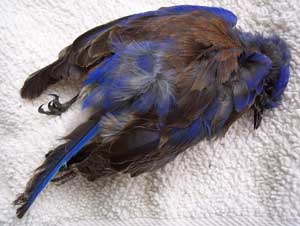
A male Western Bluebird that was trapped inside a nestbox and killed by a House Sparrow. Photo by Claudia Daigle.
This article does not delve into whether humans have a right to harvest earth’s bounty or to manipulate natural resources. However, I would like to explore a related issue – when human intervention disrupts the ecosystem, do we have a responsibility to help restore the natural balance as best we can?
Sometimes the choice is fairly easy from an ethical standpoint. Few people have a problem with the concept of controlling invasive weeds. It does require effort and patience, and they must decide whether to use manual approaches like hand pulling versus herbicides. They may be less motivated to manage an attractive alien species like Purple Loosestrife until they realize the damage it does to biodiversity.
When it comes to critters viewed as creepy or unhealthy, such as roaches or rats, many people are comfortable controlling their populations by eliminating food sources and employing humane euthanasia methods. The issue becomes more difficult and emotionally charged when dealing with other, more appealing creatures.
Take “Bambi” for instance. White-tailed deer are native to North America, but excessive overpopulation can affect animal and human health (e.g., deer starvation and disease, transmission of tick-borne illnesses, and injuries from vehicular collisions.) It can also cause property damage (to cars, landscaping, crops, etc.) Forest health and wildlife diversity, including wildflower, butterfly and grassland songbirds, suffer as a result of selective feeding and overbrowsing by deer. Therefore, wildlife biologists recommend maintaining deer populations at a sustainable level (about 10-30 deer/square mile), in balance with the rest of the ecosystem. Birth control has been tried, but has proven costly, labor-intensive, and not very effective. So far, regulated hunting has proved to be the most effective means of controlling local populations.
Another example is control of invasive House Sparrows. These aggressive, non-native birds can wipe out gentle cavity-nesters like bluebirds and chickadees. House Sparrows evict native birds from nest sites, peck their eggs, toss young out of the nest to die on the ground, and decapitate adults if they trap them inside a nestbox.
In order to help bluebird populations recover from the competition and other effects of human activity like loss of habitat and use of pesticides, some people like me put up nestboxes. Because they are attempting to attract bluebirds to the area, they feel compelled to do what they can to protect native birds that may want to nest in their boxes from House Sparrow attack. They can use passive methods like not feeding cracked corn and millet, and installing “sparrow spookers” on boxes. Many also trap House Sparrows (which are not protected under federal law), sometimes donating them to raptor recovery centers where they are “recycled” to feed injured native birds of prey like owls.
The difficult and controversial question is whether anyone has the right and responsibility to manage animal populations by active means. Personally, I believe that regulated, responsible control efforts targeted at undoing the negative impacts of human activities in order to restore balance to the ecosystem are justified. I also respect the beliefs of those who disagree with that opinion. I do, however, hope that they too will do their part to restore balance by whatever means they are comfortable with.
References and Links for more information
-
- On this website (sialis.org):
- HOSP Management (active and passive methods)
- Experiments (unproven) with House Sparrow Deterrence
- Are House Sparrows Evil? – by E. A. Zimmerman
- HOSP Biology
- House Sparrow History
- When HOSP Attack
- Euthanizing House Sparrows
- Restoring the Balance
- Wing Trimming
- House Sparrow photographs (useful for ID – nest, fledglings, adult male and female) – also see Other Brown Birds Sometimes Confused with HOSP
- Nest and Egg ID
- HOSP Proliferation
- Video Clip of HOSP Attack
- HOSP exclusion – photo of plastic netting
- How to use a Van Ert trap (with photos)
- Are Slot boxes “Sparrow Resistant?” (no)
- Handouts – HOSP Advisory
- Bluebird Widows/Widowers/Orphans
- Controlling House Sparrows Humanely, Jim Tautin, PMCA
- Best of Bluebird Classifieds: Passive and Active House Sparrow
Control - NABS fact sheet on House Sparrow control
- House Sparrows and Their Control – Alberta Agriculture, Food and Rural Development
- Internet Center for Wildlife Damage Management – House Sparrows – lists a variety of methods
- House Sparrow Revenge Syndrome, by Steve Kroenke. (Note: some dispute the existence of this behavior)
- Wild Bird Habitat
- USDA Technical Bulletin #711, ECONOMIC STATUS OF THE ENGLISH
SPARROW IN THE UNITED STATES by E. R. Kalmbach (1940). - Nothing But Trouble – article by Ed Nied
- The House Sparrow in America – article byRichard Van Vleck
- Strategies in the S&S War
- BioKids – House Sparrow
- Larry’s arrangement for hanging mono line
- Monofilament – Fawzi Emad arrangement
- D Cass fishing line set up – note: do NOT leave loose fishing line next to entrance hole.
- Photos – male and female by Gene Rollins
- Sarah’s Purple Martins and Bluebird Trail – Predator Control
- Wing Trimming (Fawzi Emad)
- Minimum Diameter for House Sparrow Entry (Frank
Navratil) - Invasive vs. Native Bird Species – article about Cornell nestbox monitoring project
- The Animals Among us, by John C. McLoughlin, 1978
- The Establishment and Maintenance of a Bluebird Nest-Box Project, A Review and Commentary by Lewis F. Kibler,
Journal of Field Ornithology: Vol. 40, No. 2, April, 1969 - Linda Violett WEBL site – HOSP Takeover data (no trapping – only nest and egg removal) – Keys to Success
- Weber WJ. 1979. Health Hazards from Pigeons, Starlings and English Sparrows: Diseases and Parasites Associated with Pigeons, Starlings, and English Sparrows which Affect Domestic Animals. Fresno, CA: Thomson Publications.
- House Sparrows, William D. Fitzwater, New Mexico Outdoor Communications. Includes drawings of various types of traps.
- Weisheit A.S. and Creighton PD, Interference of House Sparrows in Nesting Activities of Barn Swallows, Journal of Field Ornithology, Vol.60, No.3 (Summer, 1989), pp 323-328.
- HOSP Wars, Part I | Part II by Paula Ziebarth
- Restoring the Balance, E.A. Zimmerman, Our Better Nature
- Wall of Shame – HOSP nesting in signs, etc.
- On this website (sialis.org):
Sparrow Trap and Other Supply Links – also see page on Retail Suppliers
-
- Artificial Nest Black Hole (PVC) trap
- Bauldry Sparrow Trap (DIY plan)
- Best Nest two compartment ground trap
- Bird-B-Gone ground sparrow trap (2 funnel entrances)
- Bob-style trap drawings (designed for pigeons)
- Brad Biddle HOSP trap plan for DIY (a funnel trap) – see review
- Deluxe Repeating Sparrow Trap by Blaine Johnson (new design, almost impossible for birds to escape, my personal favorite.)
- Bolt trap “H” type available via snail mail at Mel
Bolt (Traps),1515 Crosswind Ct. Wooster, OH 44691 - Bruce Jenkins ground trap (this funnel trap has a very small
door with sharp edges, and comes with no instructions, birds escape if let inside too long) – see review - DIY funnel, vail, live and walk in ground traps (includes drawings) or download PDF File
- DIY traps – nestbox, funnel, etc. from a 1912 Farmer’s bulletin, with descriptions and drawings
- DIY traps – various types, in an updated 1931 Farmer’s bulletin, with descriptions and drawings
- Double door rigid sparrow trap supplied by DoMyOwnPestControl
- Internet Center for Wildlife Damage Management – House Sparrows (has some drawings of traps at the bottom)
- DIY traps, various designs with basic drawings (no dimensions) by William Fitzwater
- Havahart Model #1025 (a chipmunk ground trap) or #1020 (larger traps
will not trip for HOSP) - Gilbertson PVC nestboxes
- Gilwood nestboxes
- Henry Fields repeating ground trap
- Huber Sparrow Trap (DIY plan)
- Hunter Starling Trap (DIY plan – PDF file)
- Hole reducers (not a trap. Also know as “Squirrel Tooth
Benders” – to prevent HOSP entry, use smaller than 1.25″)
available from The Bird Watcher’s General Store, or call Wild Bird Crossing at508 347-BIRD, or Audubon Workshop (pricey), Wild Birds Unlimited (request reduced price for bulk order). 1.5″ sizes from Anything Bluebirds or Jack Finch (copper) or A Bird’s Home - Jenkins – See Bruce Jenkins Ground Trap
- Magic Halo at Wild Bird Habitat
- Mel Bolt Sparrow Trap (DIY plan)
- Northwoods Limited Sparrow Funnel Trap
- Gilbertson Universal Sparrow Trap (DIY plan)
- Steve Gruenke – 10 Minute Sparrow Trap (DIY plan)
- Pellet Guns – Cabela’s, Crosman
- PMCA traps
- Peterson Box Sparrow Trap (DIY plan)
- Review of various traps by Paula Ziebarth – pros, cons, costs,
suppliers - Sparrow Swap: Testing Management Strategies for HOSP and Exploring the Use of their Eggshells for Monitoring Heavy Metal Pollution, Hartley, S.M, 2019
- Tipping Can Trap (Van Vleck)
- Tipping Can Trap – DIY instructions (A Birds Home, Chuck Abare)
- Tomahawk Live Traps
- Trap Man repeating ground trap
- Troyer V-Trap – one source. Funnel trap for starlings and sparrows. Plans available from PMCA. Costs about $100 to build.
- Van Ert inbox traps (my personal favorite for live trapping inside a nestbox)
- Van Ert nestbox trap (cedar, hole sized 1 3/8″ to allow sparrows but not bluebirds to enter)
- Z-Trap (Starling)
