
Quick Tip: NEVER REMOVE UNHATCHED EGGS FROM A NEST UNLESS YOU ARE ABSOLUTELY 200% SURE THE NEST IS ABANDONED, OR ALL OTHER EGGS HATCHED OVER THREE DAYS EARLIER.
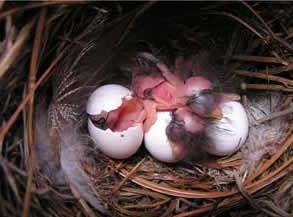
In Eastern bluebird nests, about 17% of eggs do not hatch. (BNA). Cornell’s The Birdhouse Network says that 10-15% of nests contain unhatched eggs.
Sometimes you wouldn’t know that an egg didn’t hatch because the parent removes it.
Reasons eggs don’t hatch can include the following:
- Not enough time has passed. Don’t make the mistake of throwing out viable eggs!
- Most birds lay one egg a day. They don’t start incubating the eggs until they lay the last (or in some species, the next to last) egg. This helps ensure the eggs all hatch together. So just because you don’t see adults around doesn’t mean the nest is abandoned.
- The mother may still be incubating the eggs. The length of time it takes for eggs to hatch after incubation begins depends on the species and temperatures. For bluebirds, it USUALLY takes about 12-14 days from the date the last egg was laid. Different species have different incubation periods, which can vary within a species due to temperature inside the nestbox. For example, it may take longer if the weather is cold – or the female may even wait to begin incubation until temperatures warm up. See the typical nesting timetable for the species of interest.
- Depending on when incubation begins (on the last, or next to last egg), eggs in the same nest can hatch a day or several days apart.
- It also takes a while for the bird to break through the shell.
- It could be a new egg from a subsequent nesting if you didn’t clean the box out immediately after the last fledging. (More on cleaning.) If you have just one egg, and the female is actually laying again, a new one should show up in a day or two.
- The nest was abandoned. (See widows/widowers) NOTE: People often think a nest is abandoned when it is not! If you don’t see the female going in the box/on the nest, note that some birds are secretive (like chickadees), they do have to leave periodically to eat and poop, and may spend more time off the nest when its hot out.
- The eggs were not fertile (because one or both of the parents was infertile.)
- Recent data indicates that prolonged hot temperatures could cause male birds to become temporarily infertile.
- Note: when bluebirds realize the eggs are not viable, they may build a new nest on top of the other eggs, remove them, or bury them in the original nest material and lay more eggs. In this case, the parents may have a series of unsuccessful broods where no eggs hatch (unless the male was infertile, and one or more eggs were fertilized by a different male due to an extra-pair mating.)
- The egg was a dwarf and lacked a yolk, or was a rare double yoke egg. (See weird eggs.)
- The eggs got too hot. (See heat).
- The eggs got too cold.
- The humidity was too low. When an egg loses too much moisture the membrane can adhere to the shell, and the embryo cannot free itself and dies in the shell.
- Pesticide/chemical exposure?
- There was something wrong with the embryo and it died after development started (e.g., malformed or defective in some way, or could be due to temperatures, etc.)
- The eggs were addled (possibly rolled around too briskly when the female was startled, or suffered other trauma).
- The eggshell broke (e.g., pecked by a house wren, or cracked allowing bacteria to enter.) Remove broken eggs and residue (and contaminated nesting material) to prevent the female “learning” to eat her own eggs, and to prevent attracting ants, etc.
- Half of the eggshell from another egg that did hatch was not removed by the parents, and got stuck on top of/encased an unhatched eggs egg and possibly prevented the embryo from breaking out (see photo.) If that were the case, there would probably be some evidence of pipping.
- The eggshell was weak. (Try adding calcium to suet mixes or dusting mealworms with calcium.)
- The large end of the egg (where the air bubble forms) was persistently lower than the small end, causing the embryo to become misoriented, with the head towards the small end, causing it to drown while pipping.
- The eggs were poorly incubated (e.g., because the nest was disturbed too much, food was scarce so the parents had to leave more to forage, the female was widowed, the female was inexperienced, the male was off fighting and was not feeding the incubating female.) To avoid this cause, do not monitor during the early morning or during bad weather.
- The egg belonged to a different species (e.g., a cowbird egg pushed to the side by the parent who recognized it; or an egg(s) leftover in a usurped nest where incubation was interrupted.)
- The female had a disease. In chickens, Egg Drop Syndrome, avian influenza, Newcastle disease and infectious bronchitis can all impact eggshell and internal egg quality.
REFERENCES AND MORE INFORMATION:
- Differences among cavity nesters – I find bluebirds and Tree Swallows tend to leave unhatched eggs, while Black-capped Chickadees remove them from a nest.
- Weird Eggs
- Widows/Widowers
- Candling eggs, pictures of chicken eggs
- Monitoring Tips
- Other FAQs
- Nestbox pros and cons
- Competition among cavity nesters
- Cowbirds
- Supplementing Calcium
Birds are wonderful indicators of our overall environmental health, and as the environment is stressed and biodiversity reduced through habitat degradation and loss, the most sensitive species send out the signal first.
– David Seideman, Audubon magazine, 2005
