
QUICK TIPS: During nesting season (March through August), quickly, quietly and carefully check on nestboxes once or twice a week in the afternoon so you can identify and address any problems. Avoid monitoring in early morning, dusk, or during wet cold weather, or when young are close to fledging. A little carelessness can result in accidental destruction or parents deserting a nest.
Just tap on the box and whistle or call, open the box carefully, take a quick peek inside, and close.
If you do NOTHING ELSE, please at least clean the box out at the end of the season and make any repairs, and do whatever you can to prevent non-native House Sparrows from using boxes, as they will harm the native cavity nesters the box was intended to help.
Also see an short article I wrote for my newspaper column on Ten Reasons to Check Inside Your Birdhouse
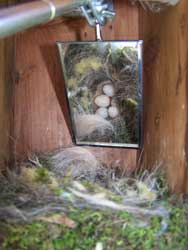
You’ve set up or inherited a bluebird nestbox, or maybe even a trail of houses. Let’s start by assuming that your goal is to encourage successful reproduction by bluebirds, Tree Swallows and other native birds that nest in cavities. If you want that to happen, you should not just put up boxes and forget about them. It’s important to periodically monitor the boxes. Read on to see why you should monitor, the frequency, what’s involved, equipment needed, and where to find out more.
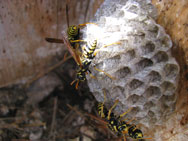
For example, in the fall I erected 12 boxes at a closed landfill. The first time I checked them in the spring, nine were filled with hundreds of paper wasps, and never would have been used, even though there were a number of bluebirds and Tree Swallows in the area.
Some purists say you should not put up a nestbox if you will not or cannot monitor it. I have seen trails where boxes are only cleaned and repaired once a year, and many were being used by native birds. If you want to INCREASE the likelihood that your boxes are used by native birds, and have more young survive to fledge, monitoring can make a real difference.
Why monitor?
- In the past, these birds nested in holes created by nature or other creatures like woodpeckers. However, once people introduced aggressive House Sparrows and starlings that evict or kill birds using cavities, allowed cats to roam, and exchanged open space for development, it became much more difficult for these native birds to survive and breed. They now rely heavily on nestboxes provided by humans.
- Larry Hebert of MO found that bluebirds had about a 65% success rate in natural cavities, and 90%+ in monitored nestboxes mounted on pipes with predator baffles.
- Bad things can happen in boxes that are not monitored. For example, wood can rot or separate, allowing chilling rain to wet nestlings. House Sparrows may attack and destroy eggs, nestlings and incubating adults. By monitoring regularly, you can prevent them from breeding in your boxes. House Wrens may fill up boxes with dummy nests, making them unavailable. Squirrels may chew and enlarge entrance holes that then allow starlings and other predators access to eggs or babies. Paper wasps or fire ants can invade boxes, preventing nesting altogether, driving parents away, or killing babies. Bumblebees or honeybees may take over, driving birds away. blow fly larvae can suck babies blood, weakening them. Mice can take over boxes. Snakes and raccoons can raid nests. Unhatched eggs can break, and nestlings can die, and rot or attract pests. Vandals may damage boxes. (Don’t panic – you can learn to deal with these problems.)
- Unmonitored boxes can negatively impact native bird reproduction in other locations. For example, if House Sparrows are allowed to breed in YOUR boxes, they may attack and kill eggs, nestlings and adult native birds nesting in other locations. If there are House Sparrows in your area, they can completely take over a formerly productive trail in one to two years.
- Data gathered by citizen scientists during nestbox monitoring is needed to increase our understanding of the natural world, and learn more about how to help native birds.
Won’t the birds abandon the nest if I monitor it ?
- Bluebirds and Tree Swallows are remarkably tolerant of humans, and will not abandon the nest as a result of normal monitoring. Most song birds have a limited sense of smell. Some other birds like Titmice are more shy (See differences). Because of this, it’s important to monitor as quietly and quickly as possible, and then move on so as not to stress the birds. You do WANT the parents to be protective of the nest (to scare off humans and predators that don’t have your good intentions) so it’s not good for them to become too accustomed to invasion.
- Do not handle eggs or nestlings unnecessarily! (See why petting nestlings is not a good idea.)
- It’s also important to keep track of when the eggs were laid or hatched, to avoid monitoring when the nestlings are older, as they could prematurely leave the nest before they are able to fly or cope with the great outdoors.
Will the birds attack me when I monitor?
- The parents (especially Tree Swallows) may swoop at you to protect their nest. That is a good thing – you want them to be defensive. But it can be scary at first. Don’t worry, they won’t actually connect, although they may come close (e.g., 2 feet). If you are really scared, wear a hat or carry a broom.
- Some birds will vocalize – e.g., chickadees will scold. Bluebirds often chatter and bill clack, and get especially excited when the young are close to fledging.
- The ONLY time I ever heard of a nestbox monitor getting hit by a Tree Swallow was accidental – the man stooped over to pick something up and then stood up quickly and the Tree Swallow was unable to avoid him.
- There is a (funny and embarrassing) video of a monitor getting pecked by a very aggressive House Wren when checking a box shortly after the eggs hatched.
- Once at dusk (not a good time) I was checking a box, and stood in front of the hole as I opened the door (bad idea.) I startled a roosting nuthatch, which flew straight out and his bill hit me in the forehead. I survived.
How often and when should I monitor?
- It depends on how serious pest or predator problems are in your area, how much data you want to collect, and how much time you have available. Once an hour is way too disruptive. Every four to five days, or once or twice a week is typical during active nesting season. (Some folks monitor every 7-10 days.) A lot can happen over that time period. But do not pester them – you don’t want them to go elsewhere.
- You only need to monitor during nesting season (spring and summer – depending on your area, usually nesting activity happens from late March through August).
- Try to monitor during calm, dry weather conditions to reduce chilling nestlings or eggs. An exception is when it rains for days – you should check to see if the nest is dry and consider providing supplemental mealworms to the parents for feeding (see more on hypothermia.) If it’s less than 50 °F out, avoid opening the box unless you suspect something is wrong. The best time to monitor is afternoon. Don’t monitor in early morning during egg laying, or towards dark.
- Don’t monitor side/front opening boxes after bluebird nestlings are 12-14 days old, to avoid premature fledging. If you observe parents feeding the babies regularly during the day, that is generally a sign that things are okay.
- If babies do prematurely fledge, and are unable to fly, try to capture them (throw a towel over them) and return them to the box. Stuff a sock in the hole until they calm down (maybe 15 minutes.) Sometimes they will jump right back out. If possible install a 1″ hole restrictor so parents can continue to feed (but cannot remove fecal sacs), but babies cannot exit, and you MUST remove the restrictor when fledging would typically occur. See more info.
What should I do when I monitor?
- Learn to recognize nests and eggs. Since House Sparrows are non-native nuisance species, you may legally remove their nests, eggs, and young. However, it is illegal to disturb the nest of any native birds.
- Make your presence known. Startling an incubating female could result in damage to eggs. Approach the box, call out or whistle and tap gently on the side, with your face away from the hole (in case a brooding bird flies out.) Open the box slowly (do not yank it open), and quickly peek inside. Be careful not to let eggs/chicks fall out! Close it slowly – a sitting female may suddenly try to exit the box and you would not want to injure it while closing the door. If you slam it shut trying to prevent premature fledging you could injure or kill a bird that gets caught.)
- Spend less than a minute checking the nest to avoid stressing the occupants and chilling eggs/nestlings.
- A car mechanics mirror is helpful to look into the nest without disturbing it. If you have a small round one that fits in a hole, place the dental mirror just inside the entrance hole and then use a pen light to bounce light off of the mirror to illuminate the nest. Don’t feel around in a nest you can’t see unless you want a surprise (snakes, mice, flying squirrel bites, black widow spiders, bumblebees.)
- Placing a plastic strawberry basket in the box prior to nest building will allow you to quickly and smoothly slide the nest out of the box part way for monitoring without touching or disturbing the contents. It will also facilitate removing blow flies, as some will drop through the bottom of the basket onto the floor. Do NOT pull the nest out of the box after the age when nestlings might prematurely fledge (13 days for bluebirds.)
- Don’t touch eggs while monitoring. Some, especially chickadee eggs, are very fragile. Also oil from hands could inhibit hatching.
- Don’t disturb the nest while monitoring (with the exception of a nest change). If you move it around, eggs or babies could get lose/fall underneath the nesting material and die.
- No nest cup – no hand! The box could have mice or flying squirrels in it. Mice tend to jump out when their nest is removed/disturbed.
- Avoid handling birds unnecessarily. If the mother sits tight on the nest when you open the box, leave her be. (It’s a good habit! Also, if you pick her up, her feet may clutch eggs/young which can then be damaged.) See why you should not pet baby birds.
- Limit photographs that might distress nest occupants. Cavity nesters are used to the dark, and since we don’t know whether baby bird’s developing eyes could be affected by a flash, avoid using one with nestlings. More.
- Move away from the box, and then make a note on a log of what you see – what kind of nest, how many eggs, how many nestlings, any evidence of problems, etc. (Note: Tree Swallows and some other nesters may refuse to budge while incubating – leave them be.)
- If there are problems, address them.
- For example, you should remove any House Sparrow nests or eggs, or render eggs infertile, or trap adults. It is better to have no nestbox at all than to allow House Sparrows to breed in one.
- If a bluebird or Tree Swallow nest has gotten wet, or is seriously infested with blow flies, make a new nest, and caulk or repair the box as soon as possible.
- If the nest is very high, exposing the nest cup contents to predation through the entrance hole, you might want to carefully lower it (by removing material from the bottom, but still allowing adequate cushioning/insulation), or move the nest cup away from the door.
- Deal with any paper wasps or mice in boxes.
- If there are any dead birds, remove them using a plastic bag/plastic gloves.
- If you are sure all eggs have hatched more than 72 hours earlier, remove unhatched eggs so they don’t break and make a mess (sometimes the parents will remove unhatched eggs eggs.)
- Make sure any baffles are in place to prevent predators for gaining access to the box.
- Close the box securely.
- If yellow-jackets (a wasp) are common in your area, watch the box for a minute or two before opening it.
- After babies have fledged, clean out old nesting material to encourage another brood. Also, detritus in old nests can attract fire ants, and the nests are sometimes infested with mites or blow fly larvae. I brush out the box, scrape it with a putty knife, and then spray it with a pre-mixed dilute solution of Chlorox (10%), open up the box and let it dry for a day, and then close the door. Do NOT breathe in dust/dried fecal matter (stay upwind, consider wearing a dust mask). Put nests in a baggie, and dispose of them in the trash to avoid attracting predators.
- If the roof is damaged, allowing water to enter the box, repair it immediately. If the entrance hole has been enlarged (allowing predators access), put a hole guard on to protect nestbox contents. Re-set loose nails, screws, box parts. Adjust the door to correct for rain swollen wood.
- At the end of the season, clean out any boxes by removing old nesting material. Do any needed repairs (caulking, re-nailing, staining exterior, re-setting loose posts or changing them out, etc.) Replace partially damaged or destroyed boxes. Leave boxes up all winter for roosting. If mice tend to use boxes during the winter, you will need to clean the boxes out in the early spring also.
What kind of equipment will I need? – See MONITORING KIT
It’s helpful a bucket, plastic bags, a spatula, soft dry grass, clean white craft feathers, a putty knife, a bar of Ivory soap or jar of vaseline, anti-bacterial wipes, disposable gloves, a dust mask, and a spray bottle of 10% bleach solution
Where can I learn more?
- Learn from the experiences of others. This website (www.sialis.org) has a page on basics, and on other great links and resources.
- Buy a good book on bluebirds (e.g., The Bluebird Monitor’s Guide) that explains how to identify birds, nests and eggs, correctly monitor an active nestbox, and prevent/deal with problems.
- Contact or join a bluebirding association or check out an online bluebirding forum.
Other resources:
- Not Your Nestbox – how to convince someone to monitor
- Monitoring Kit
- Do no harm
- Interference (and micromanagement)
- Preventing Premature Fledging (Sialis.org)
- Why you should not pet baby birds (Sialis.org)
- Migratory Bird Treaty Act (Sialis.org)
- I found an abandoned egg – can I try to incubate it? (Sialis.org)
- Monitoring Code of Conduct (Cornell, Nestwatch)
- Monitoring Fact Sheet (North American Bluebird Society)
- Bluebirding Basics (Sialis.org)
- How to Identify Nests and Eggs, with Photo Album (Sialis.org)
- Differences between bluebirds and other small cavity nesters (Sialis.org)
- The Bluebird Nut FAQs
- Great Links and Resources (adapted from The Bluebirding Forum)
- Cleaning out boxes
- Problem and Predator ID and solutions
- Monitoring Guide for Raytheon Wildlife Habitat Committee (27 p.)
- Fecal sacs
- Fecal glue
- How to do a nest change
- Predator & Problem ID and Solution
- Hanta Virus
- Avian Flu
- Spiders in nestboxes
- Snakes in nestboxes
- Tickborne illnesses
- Milwaukee 2310-21 Cordless M-Spector Digital Inspection Camera with 12-Volt Lithium Ion Battery
Sample Monitoring Forms – check with your local bluebird society:
- Monitoring Forms (The Birdhouse Network)
- Monitoring Form (BRAW)
- Monitoring Form and guidelines (LBBS)
- Monitoring Form (Alissa) – 1 page per box
- Bluebird Prognosticator (Excel spreadsheet that calculates hatch and fledge dates, etc.)
Monitoring is the very heart of the bluebirding experience…. It is only this kind of human intervention which will cause bluebirds to survive in an increasingly competitive natural world.
– Dean Sheldon, Ohio, 1998
