
QUICK TIPS: Paper wasps build umbrella shaped papery nests in boxes. The invasive European paper wasp (yellow and black) is more aggressive and will return if not killed. Most effective prevention methods are rubbing Vaseline, Ivory/Fels Naphtha soap on the ceiling, and squashing (bring a sting kit along.) See photos and more control methods.
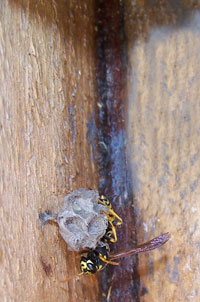
Paper wasps are nasty buggers that seem to love to quickly build umbrella shaped nests in nestboxes, baffles, and feeders. Many birds will avoid or abandon a box that has paper wasps in it – even if they have eggs or young.
IDENTIFICATION
There are over 20 different species of paper wasps (Polistes spp.) in North America. They are more likely to sting during the day when an active nest (with larvae) is threatened. The sting can be quite painful (I thought it felt like being stabbed with an electrified ice pick.)
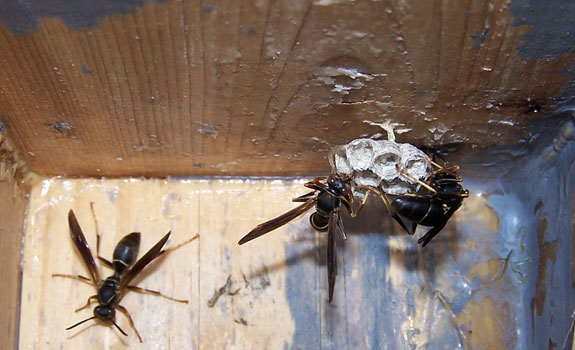
Native Paper Wasps are mostly brown, and are more active early in the season. They tend to build their nests on the interior (underside of the) roof or in nestbox corners, with the nest hanging downward. They are considered beneficial because they prey on caterpillars, etc.
The European Paper Wasp (Polistes dominulus) is an introduced species. It is yellow and black like a Yellow jacket Wasp. They are most easily distinguished from yellow jackets by their reddish-brown color with yellowish bands on the abdomen, and by their long, slender bodies. They are more aggressive than native paper wasps.
European Paper Wasps were first collected in MA in 1980 (Hathaway 1981), and since then in British Columbia, CA, CO, CT (1992), ID, IL, NJ, NY, OH, PA, VT, MD, ME, MI, MN, MO, NB, Ontario, OR, UT, WA, UT,VA, and WI. (Liebert et al.) Also, POSSIBLY (not sure) now in AZ, D.C., FL, ID, NV, NH, RI and SD? MS?
European paper wasps become most active in mid-June, although in CT I have seen nests started in April. Nest cells may face outward versus down like the native Paper Wasp (e.g., Polistes fuscatus).
In the photo on the left, notice it is starting a nest on the side of the nestbox interior, with cells facing outward vs. down. Nests are attached by a little stalk. See photos of an active nest found in the underside of a Peterson box and pupae below. Paper wasps become “imprinted” on a nest site, so just destroying the nest doesn’t work.
I have found both the native brown Paper Wasp and the European Paper Wasp in the same box. Wasps tend to show up in Tree Swallow boxes, and in boxes near the woods/swampy areas. Maybe they are more common in Tree Swallow boxes because they leave the box unattended for longer periods of time.
PHOTOS
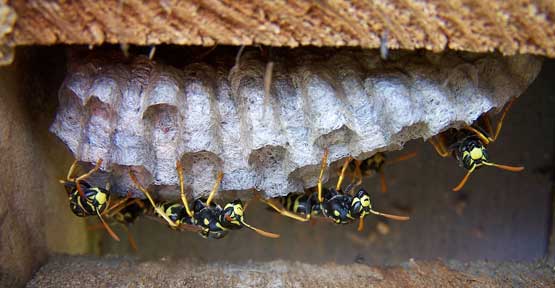
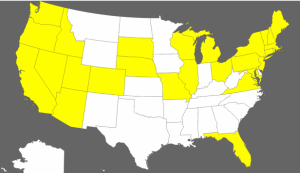 Above: Possible distribution of European Paper Wasp in continental U.S. Also found in Ontario and B.C. (2013). In MS in 2017?Above: an active European Paper Wasp nest underneath a Peterson box, with workers feeding larvae. Their presence caused bluebirds to abandon a nest with four eggs.
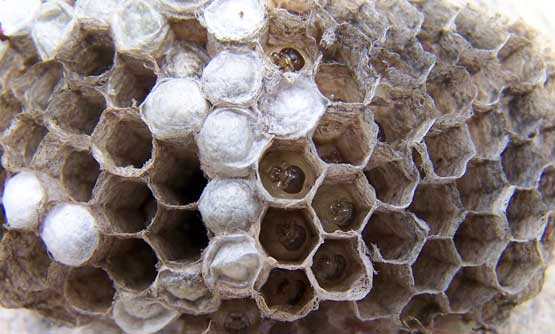
Above: Larva inside the European Paper Wasp nest.
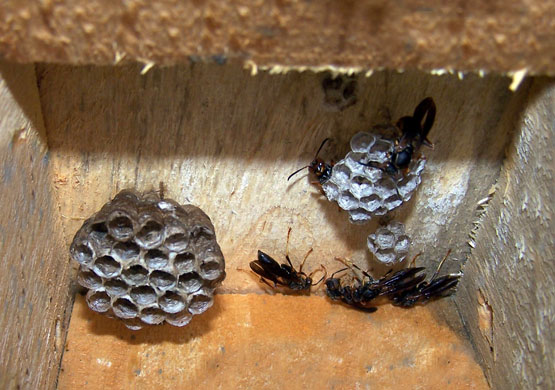
Above and below: Native Paper Wasps building nests. They are more active early in the season and tend to build their nests on the interior roof, with the nest hanging down.

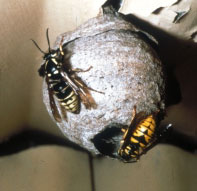
Yellow jackets: I have not seen a Yellow jacket Wasp in a box, but Richard Harlow found an Aerial Yellow jacket (Dolichovespula arenaria (Fabricius)) nest in a Great Crested Flycatcher box in VT. Their nests may hang from the ceiling, and are round with a hole in the bottom. Yellow jackets have a thicker waist than a European Paper Wasp. Photo by Howard Ensign Evans, Colorado State University, Bugwood.org.
To get rid of yellow jackets, remove any dead baby birds. Trap yellow jackets with commercial pheromone or homemade traps (put a dead fish on a string with head upside down in a bucket with 3″ of water mixed with Dawn dish soap.
CONTROL METHODS
There are several techniques to keep paper wasps from building inside nestboxes, or underneath them (e.g. on a Peterson box). Some work better than others, and some work better with native vs. European paper wasps. To PREVENT Paper Wasp nest building:
PREVENT NESTING
- Vaseline: Rub (or apply with an old paintbrush) a very thin layer of Vaseline on the interior ceiling and down sides about 1″, then wiping off excess with a paper towel (otherwise it could get on birds, especially if they are startled or exercising close to fledging.) Wooden boxes will absorb the Vaseline, so reapply several times per season. A tube of petroleum jelly (vs. a travel-size jar) is easier to work with. Unfortunately, European Paper Wasps will build on nestbox sides where Vaseline should not be used since it might get on the birds, so try soap on the sidewalls of the nestbox.
- Soap: Rub the ceiling and sides with unscented Ivory (bar) soap or Fels Naphtha soap (available in laundry detergent section). If a bird nest is present, temporarily cover it with a paper towel to keep soap flakes out, or wet it slightly first. Store soap in a ziploc baggie to keep it from hardening too much or making a mess in a bag. You may have to reapply it several times a year. (Keith Kridler said that because the wasps bring in wet paper pulp, the soap mixed in with it prevents it from drying securely to the wood.)
- Liquid soap: Cut up a bar of Ivory (bar) soap, add a little water and gently heat it on the stove. Put it in a container of liquid soap to make it easier to apply and get it into the pores of rough wood. (thanks Keith!) You can use a small, cheap paintbrush to apply it.
- Wax: Rub the ceiling and sides with canning, candle stump or crayon wax (e.g., common household paraffin – available in a box in the grocery store, usually near baking items. One brand is Gulf Wax.) This may get messy in hot southern areas, and may attract bees. I found it less effective than Ivory (bar) soap, and it is harder to get into corners.
- Spray the interior roof (and bottoms of Peterson style boxes) with a a natural pyrethrum formulation – works for 2-4 weeks. You can also pyrethrin-based caged bird spray (labeled as even safe to spray on live birds) available at pet stores.
- Neem Oil: Rub Neem oil (or oil mixed with a little Vaseline) when you see a wasp nest start or the first egg is laid. (Also helps with black flies.) “Now” Neem Oil is available at some health food stores (or on Amazon – NOW Foods Neem Oil, 1-Fluid Ounce) for about $8.99 for a small bottle with a dropper. A little goes a long way. It tends to get kind of crystallized when the weather is cooler. (Thanks Mary Mason. Neem oil is a natural pesticide extracted from an evergreen that grows in India.)
- To prevent nest building underneath the floor of Peterson nestboxes, try crumpled up paper towel, plastic grocery bag, tin foil, or latex paint.
- Rabbit fur: Staple rabbit fur to the interior roof. (I have one box from Linda Violett with this set up, and have never gotten Paper Wasps in it.)
- Stapling plastic window screening material over vent holes might help.
DESTROY NESTS AND WASPS
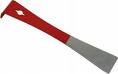
- Squashing: A good thing to carry with you when you check on boxes is a spatula (egg turner), paint scraper or a “hive tool”. Usually you have to kill the wasp to keep it from returning. It’s best to squash in the evening, when the queen and workers are in the nest, or in the early morning when wasps are less active.
- You can also spray them with a STREAM (not mist) of water from a spray bottle to make it harder for them to fly while you are crushing them. (This works on an empty box – don’t spray a nest.)
- You can also wrap a strip of duct tape around your hand, sticky side out and press it against the beginnings of any wasp nest in a box. The sticky holds the wasps and they cannot sting through the tape. Do not use insecticides except for natural pyrethrum. Native paper wasps (black and brown, with very little yellow. European versions look like yellow jackets) may be considered beneficial insects that some folks choose not to destroy. European Paper Wasps are somewhat more aggressive and likely to sting. Bring a sting kit along with you if you are squashing.
- If wasps are in an unoccupied box, put a clear plastic bag over the entire box and tape it to the pole, then crush the wasps the next day or spray the wasps with a natural pyrethrum formulation (permethrin is synthetic chemical.)
- If you are allergic to wasp stings, use boxes with slot ventilation so you can see if there is a nest inside.
OTHER OPTIONS that have been tried:
- Glue or staple aluminum foil, plastic used to create temporary storm windows, commercial plastic food wrap, or plastic from milk jugs across the interior surface of the roof.
- Try moving boxes to a different area – perhaps out of direct sunlight (as paper wasps MAY prefer boxes with more sun exposure (Blem and Blem 1991, Brush 1994, BNA).
- In 2007, I had good luck deterring paper wasps in nestboxes using nursing pads (my husband calls them “boob leaker pads”) injected with 2-3 drops of organic peppermint oil. The pads are then thumb tacked to the roof of the nestbox. I refreshed the oil once a month. It was less effective in 2008. The pads have not deterred bluebirds/Tree Swallows from nesting.
- A peppermint spray may work, but the effect on birds is unknown.
- Paint interior with sky blue LATEX paint or sand the inside top and paint it with several layers of a water-based urethane varnish. Some people do not advocate using any kind of paint/stain inside boxes. Don’t choose this method while birds are nesting, as it must dry completely before the box is used – to be on the safe side, let it cure for at least a week. Do NOT paint/varnish under the entrance hole as this could make it hard for fledglings to climb out.
- Trap the wasps (Reportedly does not work well with Paper Wasps.)
What does NOT work:
- Spraying cider vinegar on the box interior does not deter nest building, although it may kill the wasps.
- Do NOT spray the box or baffles with PAM (nonstick cooking spray). Wood may absorb it, plus (at least the store brand) it is uber-sticky on baffles and gnats get stuck all over it.
- Some folks have had luck using Bag Balm like Vaseline, but we don’t know how the disinfectant in it (8-hydroxyquinoline sulfate) might affect baby birds, and there is real potential for any stray petroleum product to gum up feathers.
- NEVER use pesticides inside a nestbox unless they are approved for use on birds or in bird cages. Even then, minimize their use, as their effects on nestlings may be undetermined.
On occasion, bumblebees will inhabit a nestbox (in particular in chickadee nests – another reason to remove old nesting material.) See control options.
Honeybees may also get in boxes. See control options.
More Information and References:
-
- European Paper Wasp – Penn State fact sheet
- More photos (by Zimmerman)
- Predator ID and Solutions
- European Paper wasp Trap – YouTube video on how to make NOTE: Colorado Extension Service says these do NOT work on paper wasps. They should work with yellow jackets.
Stung by the splendour of a sudden thought.
– Robert Browning
