
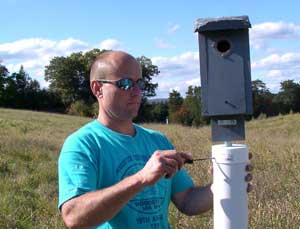
 A wobbling PVC baffle will deter many climbing mammals, but an 8″ metal stovepipe baffle topped with hardware cloth will deter both climbing mammals and snakes.
If you mount a nestbox on a tree, large wooden post, fence or telephone pole with no guard, be prepared to lose adults, eggs and nestlings to raccoons, snakes or cats. Just because you don’t have predation the first year doesn’t mean they are safe – e.g., sometimes it can take raccoons 3-4 years to find the location of a “Happy Meal.”
See Comparing Pros and Cons of Various Predator Guard Styles.
Either a Stovepipe (Kingston) or PVC wobbling baffle will guard your nestbox against climbing predators like raccoons and cats. It will also deter squirrels, chipmunks, mice, and rats as long as they cannot otherwise jump to the box. The slicker the better. (Note: some raccoons can climb up a 4″ diameter pipe, especially if they are really hungry.)
For snakes, space or distance are needed between the center pipe used for mounting the nestbox, and the surrounding baffle. This allows the snake to go up inside the baffle. On Purple Martin structures mounted on 3″x3″ steel square tubing, you can use an elevated, inverted 38 gallon trash can as a baffle.
An 8″ stovepipe guard also deters snakes. A small (4″) diameter PVC one does not, as snakes (esp. Black Rat Snakes) may be able to coil around it, even when greased. They might even be able to get past a 4-6″ diameter metal stopvepipe, so Ron Kingston (the inventory of the Kingston baffle) recommends an 8″ or larger diameter metal stovepipe.
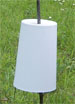
Raccoons have been known to get around metal cone guards on poles, even those that are 36″ in diameter. That size conical baffle may not stop snakes over 5 feet long, which thank goodness are not a problem in CT. Conical baffles are fairly easy to make and are good for nestboxes mounted on wooden posts. See more information on deterring cats and snakes.
A 4 foot wide flat square of hardware cloth also works, but it makes monitoring difficult, has sharp edges, and is expensive.
Another option is a Noel Guard which MAY (or may not) deter raccoons, cats and squirrels, but not snakes or medium sized avian predators. It is a little wire cage (1/2″ hardware cloth) that goes over the nestbox entrance hole.
Hardware cloth is not fun to work with – it’s stiff and cut edges are sharp, so be patient and careful.
I recommend mounting a nestbox on a metal pipe (EMT electrical conduit – 1/2″ for light boxes, 3/4 – 1″ for heavier boxes). I put a wine cork in the top of the pipe so water doesn’t get in and freeze and split it. Some folks regularly grease EMT metal conduit poles with lithium-based automotive grease, or spray with Pledge (furniture polish) or Eureka Fluid Film to make it harder for critters to climb an unbaffled pole.
What does not work well, or is not recommended:
- Use of a Bird Guardian (a commercially available plastic tube inserted into the entrance hole or screwed onto the box exterior) would provide protection against reaching predators (not snakes). However, it makes feeding more difficult and is generally not well accepted by bluebirds. Trail monitors have found that few, if any, bluebirds will use a box with a Bird Guardian on it, and some even abandon nests with eggs when a Bird Guardian is placed on a box. The instructions now indicate that it should only be used on a well established nest, and to watch after installation to verify that it is accepted. It can also create problems when opening a front opening box.
- A thick hardware block placed over the entrance hole does NOT deter raccoons (or snakes). It may make it more difficult for avian predators to reach eggs.
- Two short perches right under the entrance hole do not protect eggs or nestlings from cats or birds, according to Keith Kridler.
- Some people wrap the pole in barbed wire, put carpet tack strips on the post (which does have a deterrent effect), or use other sharp or pointed objects, but they are dangerous to humans including children, and would not be considered humane.
No predator guard is 100% effective, but a decent one is always better than nothing!
Note: Some folks just use an upside-down, 5 gallon plastic paint/joint compound bucket, with the metal bail/handle removed. Drill a hole in the middle of the bucket bottom. Keep it at the right height with a hose clamp underneath (mounted on the pole), or on two wooden blocks clamped to the pole with two long deck screws. (Thanks Dan Hanan for this description.)
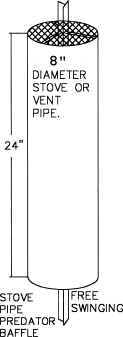 (Kingston) STOVEPIPE PREDATOR GUARD – Material List (cost is about $8):
- Galvanized stove or vent/duct pipe. 8 inch diameter (wider is better) x 24 inch long. Both can be purchased at Big Box home improvement stores, usually in the plumbing section near heat registers and furnace filters.
- Note: A black matte finish will probably rust – galvanized is better.
- Don’t get the kind with rivets (unless they are blind/pop rivets) – you want a straight, vertical seam. (The ones that you snap together are okay).
- If you can find it, try galvanized stove or vent pipe WITHOUT A SEAM (expensive, can be purchased in long sections and cut down – try Aubuchon’s or a place that sells wood burning stoves), as some snakes can climb a seam.
- You don’t have to cut it – the stovepipe comes in 2 foot sections. The 8 inch duct pipe comes in 5 foot sections.
- Circle of 1/2 inch (1/4″ is better to deter small snakes) hardware cloth that is 1″ bigger than the stove pipe. Hardware cloth is flexible wire mesh available in hardware and garden stores.
- Two hanger iron straps (also called plumbers tape), 7 inches long (these keep stovepipe from banging on pole)
- Two No. 8 B32 x 3/4 inch machine screws and nuts
This baffle designed by Ron Kingston deters snakes, raccoons, opossums and cats.
Instructions: Put the baffle on BEFORE you put the nestbox on.
- [If the stovepipe comes uncurled, put it together. You might want to put a piece of duct tape where the vertical edges meet because it’s sharp.]
- Use tin snips (offset are best) to cut a hardware cloth circle that is 1″ bigger all around than the stovepipe. Be careful of cuts and scrapes – it will be sharp! See alternative. (You can lay your stovepipe on top of the hardware cloth to draw a circle)
- Cut a small hole or “X” in the middle of the circle (the diameter of your mounting pipe – usually 1/2 to 1 inch.)
- Put the hardware cloth circle over the top of the stovepipe. Then bend the edges down one inch all around so it it fits tightly INSIDE the stovepipe.
- Use tin snips to cut three tabs in the top of the stovepipe. (Again, metal is sharp – be careful! Wear gloves.) Bend these tabs over the hardware cloth.
- Bolt the two strips of hanger iron (or a hose clamp) securely on either side of the mounting pipe, and bend them to support the hardware cloth. Duct tape wrapped around the pole helps hold the hanger iron in place, however the tape will deteriorate over time. A radiator hose clamp is better.
- Double check that there are no gaps that would allow snakes to squeeze through. You can take a slotted screwdriver and use it to pry the hardware cloth up against the stovepipe sides.
- Slip the assembled baffle over the pole until it rests on the hanger iron bracket. The top of the baffle needs to be at least four feet off the ground. The baffle should wobble a little to discourage climbing predators. Put it 3-4″ below the bottom of the box. This encourages the snake to go inside the baffle and get stopped. (If the baffle is too low, the snake might go up over the outside.)
Also see drawings and instructions here or here. Also see:
- Neil Yeager’s suggested modifications.
- Missouri Bluebird Society website for variation. It has a plastic collar with four screws (to hold it to the post), with a sort of X-shaped wood base, and the hardware cloth on top (screwed ont the wood), The hardware cloth is inset so the sharp edges don’t pose a hazard, set up on top of and a pin-wheel shaped wood base. The estimated cost is less than $10/baffle if you make 15 baffles (since you buy the hardware cloth in rolls.)
Notes:
- Don’t put a long baffle all the way down to the ground, as snakes will go up and over it. The Purple Martin Society recommends a baffle that starts 4 feet off the ground.
- If stovepipe begins to rust, snakes may be able to get purchase. Take them down, lightly sand and paint with exterior gloss or semi-gloss enamel to keep them slick and make them look better.
- The stovepipe baffle will not bang on the mounting pipe if made with hardware cloth and hanger iron per instructions above.
- Snakes (especially large rat snakes) may be able to climb a stovepipe baffle that has a seam. Try a metal “tent” baffle to seal the top of the baffle and extend it away from the pole far enough that the snake can’t go around the baffle. (Thanks Jimbee).
- When mounting nestboxes on a T-post, cut two slits (in the shape of an X) in the hardware cloth and slip it down over the post. It will be snug, but the baffle will still wobble. (Thanks Evelyn)
- If the mounting pole is not dead vertical and the stovepipe rests against the pole, snakes may be able to crawl up over it.
- A commercial guard is available but it is only 8″ tall, which will not deter most snakes. They work for squirrels though.
- If the box is mounted on a large wooden post or utility pole, you can make a version of this guard out of metal air conditioning duct, which comes in flat pieces. If the baffle is over 12″ wide it doesn’t need to wobble, as raccoons can’t hang on.
- Raccoons have been known to defeat cone baffles.
- Snakes often take babies that are just about to fledge.
- Watch out for hornet or paper wasp nests that may be built inside – to prevent this use hardware cloth top vs. solid capped stovepipe.
- Alternative to hardware cloth: use pre-made stove pipe caps instead of hardware cloth. Drill a hole in the center of each cap (slightly larger than width of the pole) and placed a flat metal disk above a large hose clamp to support the baffle but allow it to wobble. Put a few screws through the cap and the stove pipe to make sure they don’t come apart. (Thanks Nina)
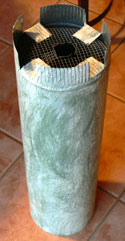 Stovepipe baffle showing tabs, with lovely camo paint by Pam Spielmann.
 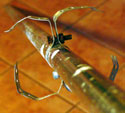 Hanger straps on pole.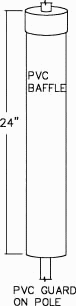
PVC PREDATOR GUARD – Material List:
- 4 inch thin wall drain pipe made from PVC (you don’t need the heavy duty Schedule 40 pipe) at least 2 feet long. (Note: 8 inch PVC works better for raccoons if the baffle is not wobbly.)
- 4 inch flat-topped PVC cap
- a few screws
- a conduit hanger or a hose clamp.
Instructions: Put the baffle on the pole BEFORE you put the nestbox on.
- In the top of the PVC cap, drill a hole in the middle that is about 1/8″ larger than the mounting pole.
- Use an oversized hose clamp (placed below where you want the PVC cap to rest on the pole – a few inches below the bottom of the nestbox) to make the baffle swing freely and wobble.
- Glue (plumber’s glue) or put a screw through the PVC cap so it doesn’t come apart.
Notes:
- This baffle will prevent mice, raccoons, cats, etc. from climbing the pole. It CAN be climbed by snakes!
- It can be painted with Rustoleum paint for plastic, or Krylon paint to blend in. I use forest green.
- This set up may be more expensive than the stovepipe.
- Some users have had problems with paper wasps nesting underneath the PVC cap.
MORE INFORMATION:
More Information:
- The problems associated with mounting boxes on trees
- How to make a wobbling stovepipe guard
- How to make a conical baffle
- How to make a Hutchings PVC “coon” guard
- Predator and Problem ID and solutions
- Snakes as Predators
- Krueger Snake Trap made of garden netting
- 1/2” Conduit/Rebar Pole Mounting System (Gilbertson) – PDF file with excellent photos
- Video of raccoon attacking nestbox
- FAQ: Is it safe to mount a nestbox on a tree?
- Mounting and baffle drawings courtesy of the North American Bluebird Society website.
- Thanks to Pam Spielmann for stovepipe baffle photos.
- Some information here is from The Bluebird Monitor’s Guide
- Also see Lance Gardner’s website showing baffle setups.
We do not just fear our predators, we are transfixed by them. We are prone to weave stories and fables and chat endlessly about them.
– Peter Benchley
