
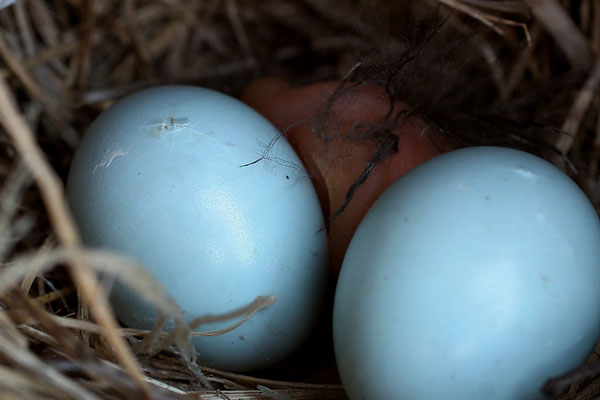
If the egg is incubated, the embryo inside develops. The parent(s) periodically rotates and rearranges eggs in a nest to ensure equal heating. This also prevents the shell membrane from adhering to the shell, which could interfere with hatching.
- First, circulatory, digestive and respiratory, and nervous systems start to differentiate.
- Then limbs may begin to move.
- An egg tooth is formed to help the bird break out of the shell when it hatches.
- The yolk sac gets smaller. In preparation for hatching, the embryo is in a tucked position. It uses its bill to puncture the innermost shell membrane at the blunt end of the egg (called internal pipping.)
- The embryo begins to breathe the pocket of air between the inner and outer shell membrane.
- After a few more hours, the egg tooth is used to break through the outer shell membrane and the shell (called external pipping – see cracks and holes in photo above.)
- When it penetrates the shell, the hatchling emerges from the egg.
- The parents generally do not help the young get out of the shell, although they may watch intently. They may remove or eat the egg shell after hatching.
More Information and Resources:
- Egg production
- How Many Eggs Will a Female Lay?
- Why didn’t the eggs hatch?
- Weird eggs (various species)
- Egg sizes (comparison table) for various small cavity nesters
- Nest and Egg Identification (photos and descriptions)
- Newborn bluebird photo
- Eggbound female
- Photo of blood smears on eggshell
- Supplementing Calcium – Feeding Chicken Eggshells, etc. to Birds
- I found an egg – can I hatch it?
- How does a bird embryo breathe inside the egg?
- The Amazing Egg
Previous Pictures of the Week: © Original photographs are copyrighted, and may not be used without the permission of the photographer. Please honor their copyright protection. If you would like to use a photo for educational purposes, you can contact me.
- Tips for photographing cavity nesters
- June 11, 2006 – Great Crested Flycatcher
- June 19, 2006 – Snake Lick
- June 26, 2006 – House Finch Nest
- July 3, 2006 – Tree Swallow in Flight
- July 17, 2006 – Bluebird Battle
- July 24, 2006 – Bear Attack
- August 1, 2006 – Neglected Nestboxes (House Sparrow nests)
- August 14, 2006 – Threesome (Bluebird Babes)
- August 28, 2006 – Peering (flicker)
- January 2007 – New Hill Trail (Sialis)
- February 12 2007 – Sharp-shinned? Hawk feeding on dead starling
- February 19, 2007 – Joe’s Cafe (Suet/Mealworm Feeder)
- March 25, 2007 – Sunflower Eater
- February 2007 – Snags & Suet (Pileated Woodpeckers)
- May 2007 – Birdcam Shots and Birdcam Photo Album
- May 12, 2007 – Carolina Wren nest in a boot
- May 25, 2007 – Batman Bird (Tree Swallows)
- June 2007 – Bluebird nest of cattails, one with leaves, and a TRES nest with maple seeds
- June 20, 2007 – Nine Egger (Tree Swallow nest)
- June 27, 2007 – Black-capped Chickadees (funny and serious photos)
- July 7, 2007 – Anting and Sunbathing
- Red-shouldered Hawk perching on nestbox
- November 18, 2007 – Western Bluebirds at the Spa
- March 15, 2008 – Under Construction – Eastern Bluebirds Building a Nest
- April 9, 2008 – Bluebird Battle in PA
- April 10, 2008 – Mouse Surprise
- April 15, 2008 – Bluebird News (nest in paper box)
- April 23, 2008 – My personal nightmare
- April 25, 2008 – Brave White-breasted Nuthatch
- April, 2008 – How an egg hatches
- May 3, 2008 – Newborn Blue (baby hatching)
- May 3, 2008 – Brave Blue (female on nest)
- May 14, 2008 – House Wren Havoc (eggs pecked)
- May 25, 2008 – House Wren Takeover (of nest, more pecked eggs)
- May 29, 2008 – Take Your Pick (parents feeding fledgling)
- June 10, 2008 – That Look Belongs in a Holster (female MOBL)
- August 23, 2008 – Cat on Nestbox
- September 28, 2008 – HOSP on the House
- October 10, 2008 – Cuddling nestlings (taken in summer time)
- October 27, 2008 – HOSP in flight
- October, 2008 – Possible double and dwarf egg in one nest
- December 16, 2008 – The Next Generation (children building boxes)
- January 22, 2009 – Blue with Cold
- January 28, 2009 – Prothonotary Warbler on a camper | Nest building PROW | PROW nesting in tree cavity
- May, 2009 – To Kill a Mockingbird (Snake eating mockingbird – may be disturbing)
- May 21, 2009 – Should I Stay or Should I Go Now? (Titmouse nestling in box)
- May 25, 2009 – Which of these is not like the others? (Cowbird egg)
- May 23, 2009 – The Honeypot at the end of the rainbow (bumblebee nest)
- June 20, 2009 – House Wren nest decorated with Western Bluebird feathers
- June 20, 2009 – Wonderful WEBLS of WA
- June 20, 2009 – Bluebirds of Bickleton
- July 12, 2009 – Hairy Shrimp (newborn bluebirds)
- July 2009 – Diet (bluebird with earthworm in beak)
- July 2009 – Bluebirds nesting outside of cavity
- July 19, 2009 – HOSP on Holiday
- July 20, 2009 – Pink bluebird eggs
- August 2, 2009 – Pinkies (baby mice)
- August 2, 2009 – En garde (male bluebird in box)
- September 29, 2009 – 1917 instructions for bird house construction
- I forget when – Rainbox
- April 11, 2010 – nuthatch bark
- April 12, 2010 – My first white egg
- April 12, 2009 – TUTI nest by Keith Kridler
- May 2010 – TUTI newborns
- May 2010 – Christmas Chickadee
- May 2010 – Bluebird and Chickadee eggs in the same nest
- June 2012 – Paparazzi
- April 2013 – Under Construction – Titmouse nestbuilding
- July 2013 – Pink Bluebird Eggs
- July 2014 – Cowbird egg in Eastern Bluebird nest
- July 2014 – Newborn HOSP
- July 2015: Patience Pays (Male Eastern Bluebird)
I love the excitement of opening the box and looking inside not really sure what kind of eggs I will discover. Sort of like fishing in the ocean!
– Vicki Butler, Bluebird_L, 2006
