
CONTENTS: Pairing, Spacing, Defense, Other Species, Variety, Usage, Direction, Impact on Tree Swallow Population, Statistics, Definitions, More Info.
QUICK TIPS: If Tree Swallows are overwhelming your trail, you might try pairing boxes 5-20 feet part, and then spacing the pairs the correct distance for your species of bluebird (125-150 yards apart.)
Bluebirds are territorial, and two pairs generally won’t nest in boxes that are closer than 125-300 yards. However, you can pair boxes in the hopes that two different species will nest side-by-side.
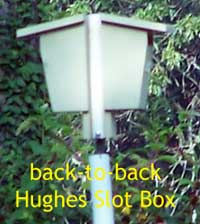
PAIRING: Tree Swallows (TRES) sometimes work in mobs and can overwhelm a bluebird. If nesting bluebirds are harassed by Tree Swallows (TRES), or more than 50% of bluebird trail boxes are occupied by swallows, try setting up a second, “paired” box 5-20 ft. away from the first. Some people recommend putting pairs 5-15 feet apart, some no more than 10, others 12-18, others 20-24. Then space your pairs as recommended for your local species. Boxes can even be placed back-to-back (see photo of Hughes box), on a pipe or utility pole (see plan and photo) although I don’t know how often box boxes get used (there are reports of simultaneous usage by TRES and bluebirds). Steve Eno suggests placing unpaired boxes 150 yards apart (instead of 100) to give bluebirds an edge.
Boxes that are 25 or more feet apart may both be used by TRES. In some cases, TRES will even nest 10 feet apart, especially in areas abutting open space where populations are high or food supplies are abundant. The NJBS reported that “after tree swallows have begun brooding their clutch, they will permit another pair of swallows to nest in the paired box if it is not occupied. This happens in less than 10% of box pairs.” (NJBS newsletter Jersey Blues Vol2, Issue 1, 2017.) In 2006, after pairing for 4 years, Kilduff had TRES in both boxes paired 22 feet apart. I am not aware of TRES nesting in both boxes that are back-to-back.
Personally, I have not had much success with pairing – the second box either ends up with a dummy nest, a nest without eggs (which perhaps were poached), or empty.
- BRAW of Wisconsin no longer recommends pairing, as they found they get higher bluebird productivity with single boxes spaced more than 100 yards apart. They also found that crowded singles boxes (spaced from 100 feet to 100 yards apart) are less productive, in part due to high interest from House Sparrows and House Wrens. (Note that BRAW considers boxes 100 feet apart to be paired. I do not use that definition.)
- Middle Creek Pairing experiment: The PA Game Commission found that Bluebirds and Tree Swallows nested successfully nest as close as one foot apart on side-by-side pairs. They did not have TRES in side-by-side boxes that were 10-20 feet apart, perhaps because they had the choice of other boxes spaced farther apart. They had 28 back-to-back pairs, in 1999, they did have a few TRES successfully nest in BOTH boxes at two back-to-back sites, but not at exactly the same time. TRES nested in 20 of the 28 back-to-back pairs, while the other box at 18 of these sites remained empty or was used by bluebirds. The found that when Bluebirds and TRES nested at pairs, they rarely did so at exactly the same time. Once their young hatch, they are so preoccupied with feeding that they cannot defend a second box, and once both species have established their nests, aggressive behavior seems to wane. (TRES usually once have one brood per year – Bluebirds may have 1-3.)
- Some birds are more territorial than others. Haleya Priest of MA and Paul Kilduff of MD both found 10 and 15 foot pairing too close, and had to pair 22-24 feet before Eastern Bluebirds (EABL) would quiet down and let TRES nest next door. Occasionally, bluebirds will build nests in both boxes of a pair (confusion? territoriality?), laying eggs in only one.
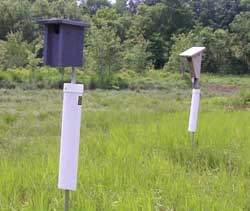
SPACING between pairs: A pair of boxes can then be spaced 100-300 yards apart if you are trying to attract bluebirds. For Western Bluebirds, NABS recommends 100 yards, Eastern 125-150 yards, and Mountain 200-300 yards between boxes (or pairs of boxes.) So if you pair boxes for Western Bluebirds, you will have two boxes 5-20 feet apart, and then the next set of paired boxes will be 100+ yards away from the first pair, and so on.
 DEFENSE: With paired houses, Bruce Burdett has found that TRES and bluebirds nest side by side without strife. TRES may help defend both boxes. In theory, pairing could potentially reduce House Sparrow (HOSP) or House Wren attacks if occupants of both boxes work together to defend the nest sites. Tripled boxes might work even better. Another advantage noted by Fawzi Emad is that if a HOSP shows up, it may claim the empty box of a pair, making it easier to trap the HOSP. However, on the other hand, if there are no TRES, paired boxes might actually make it HARDER for the bluebirds, as they may get distracted trying to defend two boxes from HOSP.
If HOSP are a problem in your area, it’s doubly important to monitor paired boxes and manage HOSP, as HOSP will not hesitate to occupy boxes that are right next to each other. Neglected boxes can result in a HOSP population explosion. See more discussion.
OTHER SPECIES: Since different species have different eating habits (e.g., TRES eat on the fly, bluebirds generally hunt bugs on the ground), they can each occupy their own niche even though their nestboxes are very close.
Pairing works with species other than TRES, including Violet-green Swallows. Chickadees (Carolina and Black-capped) have successfully nested in paired boxes alongside bluebirds or Tree Swallows. Since chickadees are likely to lose out to bluebirds in a nestbox competition, putting up a paired box (perhaps with a hole restrictor) may allow them to nest in an area where choices are limited.
Be careful if a House Wren uses one box in a pair, as they may attack eggs/nestlings in the nearby box, or fill it up with sticks.
VARIETY IS THE SPICE OF A TRAIL: I like to pair two different kinds of boxes (e.g. a Gilbertson with a Peterson) to try to get a sense of which species prefers which box style. You might also try putting the paired boxes at different heights, or put up boxes with different floor sizes (e.g., larger for Western Bluebirds) to address species-specific preferences.
DIRECTION: I have not seen any definitive information on whether paired boxes should face in the same or different directions, away from or towards each other. One study of natural cavities indicated bluebirds and Mountain Chickadees may prefer north and east facing holes, and swallows may prefer south and southeast facing holes (Aitken, Fall 2003 Bluebird journal). The study indicated that “benefits of a particular cavity orientation may depend on the openness of the surrounding habitat, location of gaps in tree canopy, and other features such as the location of streams or ponds, woodland edge, and nearby obstructions.” It might be a good idea to try variety again. In any case, face all entrances away from prevailing winds to avoid allowing rain or cold wind inside the box.
USAGE: Pairing will not increase the number of bluebirds nesting per area, since they prefer not to nest close to each other, but can prevent all available boxes from being taken over by TRES.
Sometimes one box in a pair will go unused. I don’t worry if one does not get used initially. I figure it’s always useful to have an open box if a bird like a chickadee re-nests (they will not re-nest where they had a failed nesting), or a bluebird elects to have a later brood in a different location. There are some anecdotal accounts that bluebirds appear to prefer to nest in areas with an empty (fall back?) nestbox nearby.
Some birds (bluebirds, Titmice, possibly TRES) will occasionally build a nest in both of the paired boxes, but generally only lay eggs in one (Orthwein). See more info on dummy/abandoned nests. If they happen to lay eggs in both, they will only incubate in one box, and you could relocate the extra eggs to the box they decide to use as soon as incubation begins.
This year I have had what appear to be TRES nests in both boxes that are less than 18 feet apart, but one does not have eggs, and only has a feather or two. I assume it is either a dummy nest, abandoned, or the dominant TRES pair removed the eggs.
IMPACT ON TREE SWALLOW POPULATION: Some folks worry that putting up paired boxes might increase Tree Swallow populations to the point where they completely take over. On my trail, bluebirds show up first and thus get first dibs for the first brood at least. Also, TRES usually only have one brood per year (bluebirds may have 2 to 4), and a lot of TRES nestlings die during inclement weather.
The Bluebird Restoration Association of Wisconsin’s (BRAW) somewhat controversial but voluminous data suggests that box pairing shifted the bluebird/TRES production balance downward, in favor of TRES, and they now recommend de-pairing (spreading out) boxes. On the other hand, Bruce Burdett of NH indicates he has never had a SUCCESSFUL bluebird nesting in a house that was not paired (~15 feet apart) with another.
If you want to maximize your bluebird production PER BOX, maybe you should go widely spaced singles (100-300 yards apart). Personally, I’d rather fledge more native cavity-nesting birds overall, and travel shorter distances to monitor them. I would like to try back-to-back boxes, as it would save on poles and baffles. I’d suggest you experiment, keep good records to assess what impact pairing has on your trail, and do whatever works best in your area.
STATISTICS: As Linda Janilla noted, when pairing boxes, bluebird fledging rates PER BOX will appear to decrease. I think you should count fledging rates PER PAIR to get a more accurate comparison of success/failure in your area.
DEFINITIONS: Be careful when looking at studies, as some (BRAW for instance) have defined boxes as “paired” when they are 100 feet apart. I choose to define pairing as boxes that are 5-20 feet apart, perhaps after hearing Bruce Burdett define it that way on the Bluebird_L 724 times (if not more).
References & More Information:
- Observations on Pairing Bluebird Nestboxes by Kevin Berner
- To Pair or Not to Pair by Steve Eno
- Pairing houses: How do you do the math? by Linda Janilla
- Grid set up for nestboxes
- Nestbox Competition – who trumps who
- Nestbox guide – hole and floor size by species
- Tree Swallow educational site (nestboxes, site selection, banding, record keeping, etc.)
- Bluebird Basics
- All About Tree Swallows
- All About Black-capped Chickadees
- Dummy and Abandoned Nests
It may well be true that in different areas of the country different ecological situations lead to different relationships in regards to which Bluebird management strategies work best. I don’t think that people in every corner of the continent should blindly follow my recommendations …or those of any other individuals or groups.
– Kevin Berner, Bluebird, Vol.25, 2003
